How to check whether your dentist in Italy is licensed
Leggi in Italiano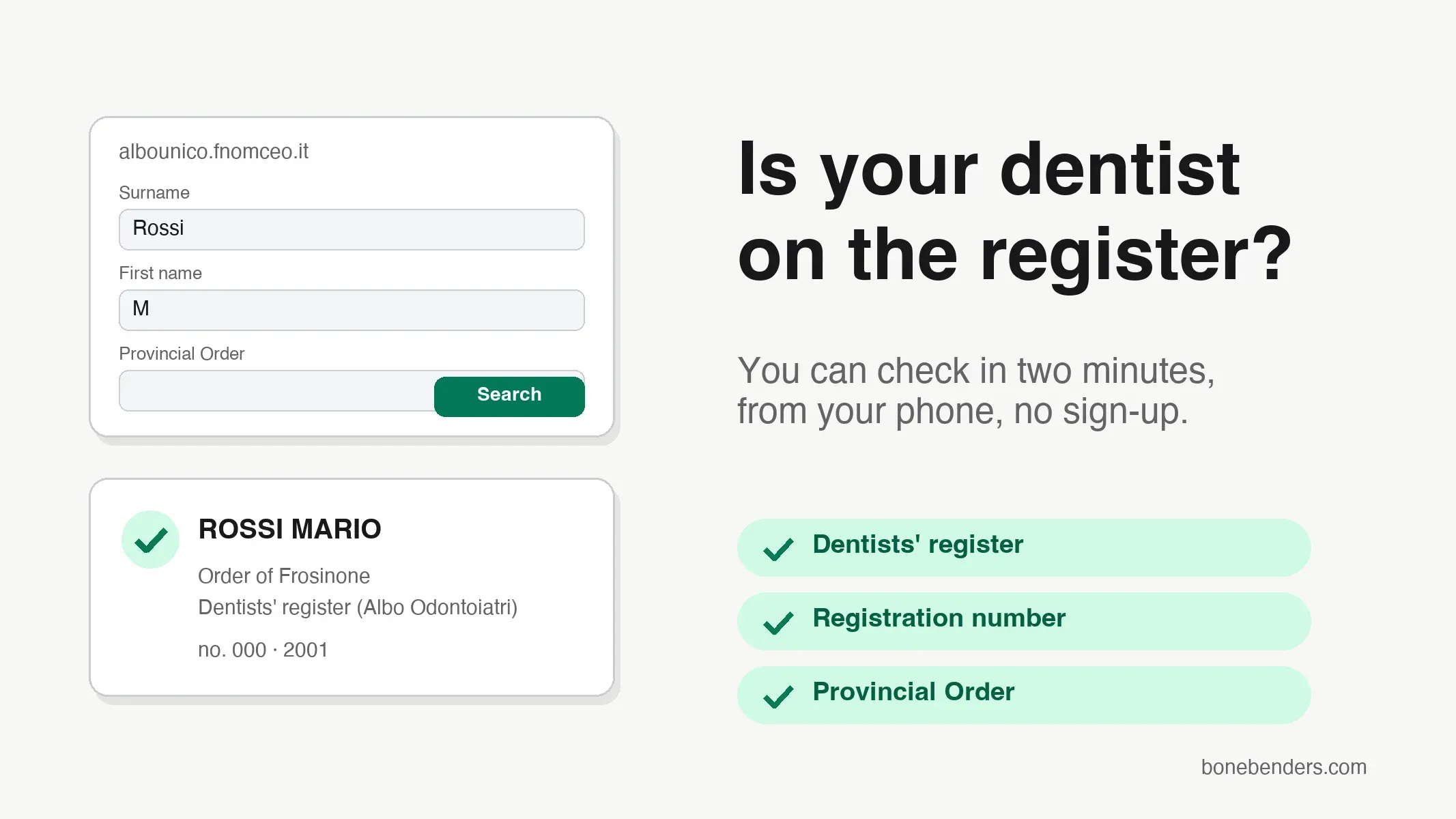
In brief — Italy’s national register of physicians and dentists is public, opens on a phone with no sign-up, and tells you whether the person treating you is on the dentists’ register, with which provincial Order and since when. Full surname, partial first name, two minutes. If the name is missing, ask the practice for the registration number and confirm it with the provincial Order before anyone puts their hands in your mouth.
A public register almost nobody opens
Estimates circulating among the professional Orders and dental associations put at around 15,000 the people in Italy who treat teeth without a licence. It is an estimate, and the people who make it say so first. The certain fact is a different one. A national, public register exists, kept up to date by the 106 provincial Orders, and in two minutes it tells you whether the surname on the brass plate belongs to a licensed dentist. In thirty years of practice I cannot recall a patient telling me they had looked it up before the first visit.
It takes less time than reading the Google reviews. And it tells you something reviews cannot.
If you live in Italy and your Italian is limited, the register is still usable. The form has three fields and I translate them below.
What the register tells you, and what it does not
The national federation of the Orders of physicians and dentists, FNOMCeO, keeps two separate lists: the national register of physicians (Albo Unico dei Medici Chirurghi) and the national register of dentists (Albo Unico degli Odontoiatri). The data come from the provincial Orders, which remain responsible for keeping them current.
For each professional you find the Order they belong to, the register they are listed in, the registration number and the registration date. Since March 2026, during a technical overhaul of the system, the federation publishes only the data required by law. Master’s degrees, doctorates and postgraduate courses will follow once a regulation makes them consistent across provinces. If you need that information today, the provincial Order’s own register has it, or you ask the dentist directly.
One warning at the bottom of the register’s page also concerns this site. Consultation is allowed for information and in the public interest; copying, downloading or redistributing the data for commercial purposes is forbidden. No private website, mine included, may replicate that search. What I can do is show you how to use it.
The search, step by step
Open albounico.fnomceo.it and stay on the “Professionisti” tab.
- Cognome is the surname. Type it in full; it is the only required field. If it contains an accented letter and nothing comes up, try the letter followed by an apostrophe (Donà becomes Dona’) and then without the accent (Dona): the Orders send their data in different formats.
- Nome is the first name. A few letters are enough. With a common surname it is worth filling in, or you get a long list.
- Ordine della provincia di is the provincial Order. Optional. A dentist registers in the province where they live or work, which does not always match the province of the practice where you meet them. If a first attempt with the province returns nothing, repeat without it.
- Cerca means search. Then open the record.
On the record, three checks.
The register is the dentists’ one. Look for “Odontoiatri”. That is the title required to work in a patient’s mouth. A physician listed only under “Medici Chirurghi” cannot practise dentistry, with the exception of the generations that predate the dental degree, covered below.
A registration number and date exist. The number is the one you often find on the brass plate, on prescriptions and on the practice’s website. If the practice displays it, compare it with the record.
The name is exactly that one. A namesake registered in Bolzano is no use if the practice is in Latina. If in doubt, call the Order of the province shown: they answer the phone and will confirm a registration.
Who may do what in an Italian dental practice
Law 409 of 1985 created the profession of odontoiatra, the dentist, and the register that holds it. Since then, treating teeth requires the degree in Odontoiatria e Protesi Dentaria, the state licensing exam and registration with the dentists’ register.
The physicians of the earlier generations remain. Those who began medical school before 28 January 1980 could join the dentists’ register directly. Those who began between 1980 and the end of 1984 could do so after an aptitude test or with a dental specialty. They are colleagues now all past sixty, often excellent, and you will find them listed in both registers. A physician who began later, without a dental specialty, may not practise dentistry.
The dental hygienist (igienista dentale) is a licensed health profession with a three-year degree and its own register, kept by the TSRM and PSTRP Orders. The 1999 professional profile is precise. Scaling, root planing, hygiene education, on the dentist’s indication. Diagnosis, anaesthesia, fillings and extractions are out of scope.
The dental technician (odontotecnico) builds the prosthesis. They do so in a laboratory, on the dentist’s prescription, and the 1928 regulation that still governs the trade forbids any procedure, invasive or not, in the patient’s mouth, even with the dentist present. The reform of the health professions debated in 2026 restated that boundary: the technician’s role remains manufacturing the device, with no direct intervention on the patient, and the Government has until the end of the year to update training and competencies. Whoever “tries the denture in your mouth” must be a dentist. If you notice it is the same person who built it, and that person has no dental degree, you are looking at the most common form of unlicensed practice.
If the name does not come up
The harmless explanations first. Accent or apostrophe in the surname, a double surname written in a different order, the wrong province, a recent registration not yet synchronised: the federation itself warns of temporary mismatches with the provincial registers. Repeat the search without the province and with the surname variants.
Then the foreign qualification. A dentist who graduated in another country may work in Italy only after the Ministry of Health has recognised the degree and a provincial Italian Order has admitted them. If they practise here on a stable basis, they are in the register. If they are not, the foreign degree alone is not enough. This matters for expatriates who choose a dentist from their own country: the passport does not replace the Italian registration.
If the name is still missing after these attempts, ask the practice for the registration number and the province of the Order. It is a normal question, and a professional answers in ten seconds. With those two pieces of information you call the Order and close the matter. If the practice does not answer, or changes the subject, you have your answer.
In November 2024 the president of FNOMCeO, Filippo Anelli, after several serious cases linked to aesthetic medicine promoted on social media, urged the public to check professionals’ registration and titles on the register, adding that doctors have a duty to explain their training to patients. It applies to dentists in the same way.
What unlicensed practice costs
Law 3 of 2018 rewrote article 348 of the Italian Penal Code. Anyone who unlawfully exercises a profession requiring a state licence risks six months to three years in prison and a fine of 10,000 to 50,000 euros. Conviction brings publication of the sentence and confiscation of whatever served to commit the offence, so equipment and premises.
The paragraph that concerns my colleagues is the third. A licensed professional who employs an unlicensed practitioner, or directs their work, risks one to five years and a fine of 15,000 to 75,000 euros, with the sentence forwarded to the Order for suspension. It is the rule written for the practice where the dentist signs and the technician operates. Reports go to the provincial Order or to the NAS, the Carabinieri’s health unit, and the Order may join the proceedings as a civil party.
What the register does not tell you
Registration is the floor. It says that person may treat you, not how well. For a major procedure the indicators are elsewhere: how many of those procedures they perform each year, their postgraduate training, whether they explain the alternatives and put the proposal in writing. None of that appears in the record.
Neither does the price, and price is the lever by which unlicensed practitioners find you. A quote far below the others almost always has an explanation, and sometimes the explanation is that the person quoting has no degree. I have written about what cheap dentistry really costs, and that case was not the worst I have seen.
What to do, in order
Look up the surname in the national register before the first visit, not after the quote. At the visit, watch who puts their hands in your mouth and ask yourself whether it is the same person as the record. If someone else steps in, ask who they are and what they do. A hygienist removing tartar is normal; a “technician” trying your denture or adjusting an appliance is not.
It will not pick the best dentist for you. It takes the worst risk off the table, and it does it in two minutes.
This is the first check I recommend to anyone who comes to our practice in Frosinone with a denture or an implant made elsewhere and some doubt about who made it.
Dr. Ernesto Bruschi — periodontist and implantologist, Centro Odontoiatrico Denti Più, Frosinone, Italy. Registered with the dentists’ register of Frosinone, no. 594, verifiable on the FNOMCeO national register. ORCID: 0000-0002-4773-5384.
References
-
FNOMCeO. Albo Unico Nazionale dei Medici Chirurghi e degli Odontoiatri — Ricerca professionista. albounico.fnomceo.it. Accessed 9 September 2026.
-
Law 24 July 1985, no. 409. Istituzione della professione sanitaria di odontoiatra e disposizioni relative al diritto di stabilimento ed alla libera prestazione di servizi da parte dei dentisti cittadini di Stati membri delle Comunità europee. Text on portale.fnomceo.it.
-
Law 11 January 2018, no. 3, art. 12 — Delega al Governo in materia di sperimentazione clinica di medicinali nonché disposizioni per il riordino delle professioni sanitarie (new text of art. 348 of the Penal Code, unlawful exercise of a profession). normattiva.it.
-
Royal Decree 31 May 1928, no. 1334. Regolamento per l’esecuzione della legge sulla disciplina delle arti ausiliarie delle professioni sanitarie (art. 11, dental technicians). normattiva.it.
-
Ministerial Decree 15 March 1999, no. 137. Regolamento recante norme per l’individuazione della figura e del relativo profilo professionale dell’igienista dentale. normattiva.it.
-
Legislative Decree 9 November 2007, no. 206. Attuazione della direttiva 2005/36/CE relativa al riconoscimento delle qualifiche professionali. Procedure on the Ministry of Health website.
-
FNOMCeO. Medici e pubblicità social, Anelli: “Verificare che i professionisti siano iscritti all’Albo e i loro titoli”. 13 November 2024. portale.fnomceo.it.
-
Odontoiatria33. DDL professioni sanitarie, sì all’emendamento di riforma delle arti ausiliarie sanitarie. 2 July 2026. odontoiatria33.it.
-
ANDI Bologna. Abusivismo negli studi dentistici, un problema ancora troppo diffuso (estimate: around 15,000 unlicensed practitioners in Italy). andibologna.it.
FAQ
Where do I check whether a dentist in Italy is registered?
My dentist is listed in the physicians' register but not in the dentists' register. Can they treat my teeth?
Does a dentist trained abroad have to be registered in Italy?
Can the dental technician try the denture in my mouth?
If they are registered, does that mean they are good?
What does someone risk for practising dentistry without a licence?
Go deeper
Espansione crestale (split crest) →Allargare la cresta senza trapianto — tecnica ERE e bonebending
Need a professional opinion?
Book an appointment at Dr. Bruschi's practice in Frosinone. First visit includes full diagnosis and personalised treatment plan.
Stay Updated
New articles on periodontology, implantology and oral surgery — delivered to your inbox.
Comments
Loading comments...
Leave a comment