All-on-4 or All-on-6: the cantilever outweighs two extra implants
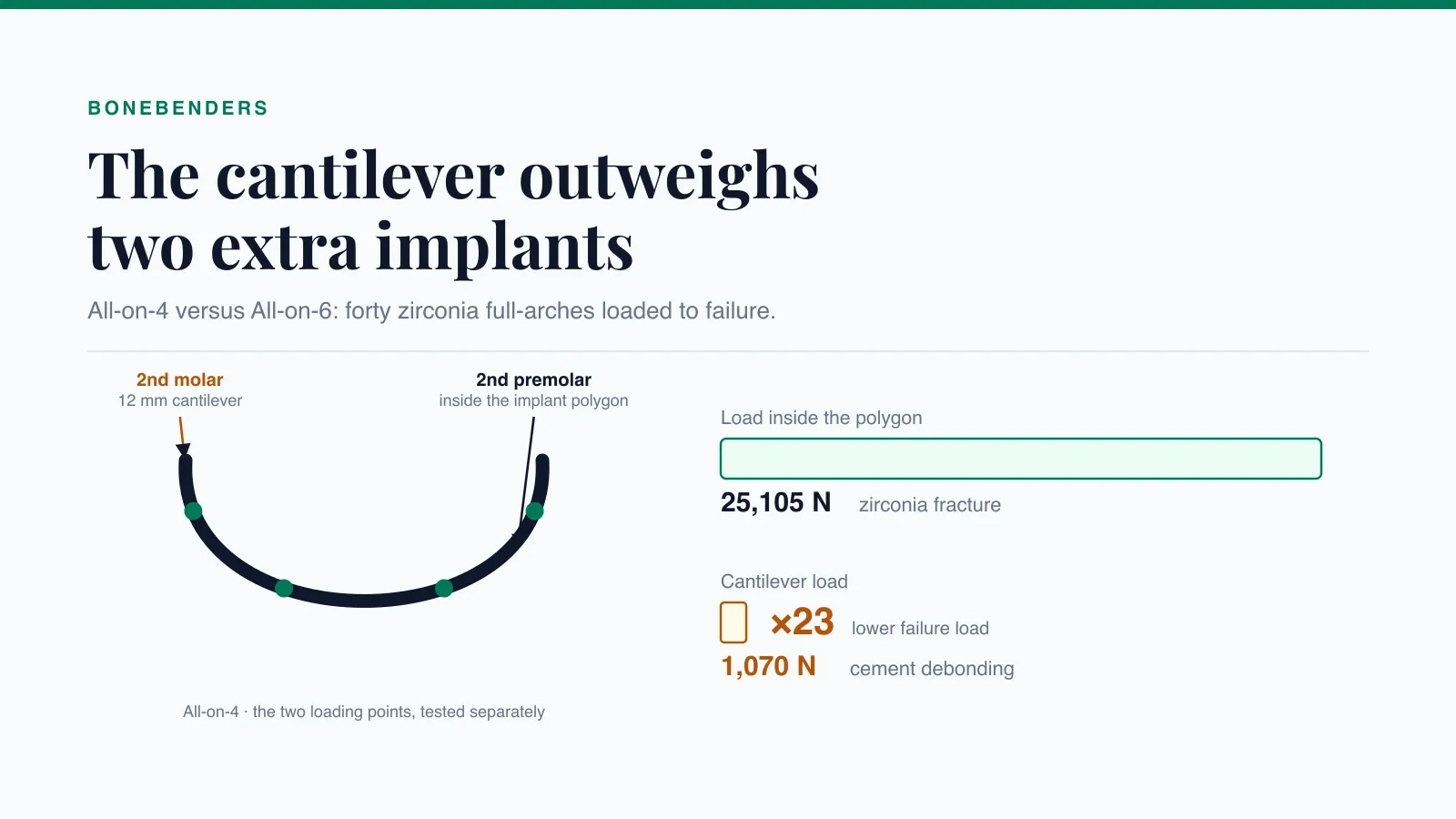
In brief — Forty monolithic zirconia full-arches loaded to failure on the bench. Going from four implants to six did not change the failure load inside the implant polygon. Loading the cantilever cut strength by more than twenty times and moved the failure from the zirconia to the cement.
Twenty-five thousand newtons to snap a zirconia full-arch. A little over a thousand to peel it off the copings, pushing out on the cantilever.
Two numbers from the same study, on the same restorations. Only the loading point changes.
Zhou and colleagues, working between the implantology department at Peking University and the Beijing Institute of Technology, milled forty monolithic zirconia prostheses, bonded them to titanium copings, and loaded them to failure on a universal static testing machine. Twenty on four implants, twenty on six. Each group was loaded at two points: the second premolar, inside the implant polygon, and the second molar, out on the cantilever. The cantilever measured 12 mm in both designs.
Worth saying up front: this is bench work, on rigid titanium-alloy bases, under static load. I come back to that at the end.
Two more implants changed nothing
The authors started from a reasonable hypothesis — more implants, more resistance. They rejected it themselves.
Loaded inside the implant polygon, the four-implant prostheses failed at 25,105 N on average, the six-implant ones at 27,189. A difference, and not a significant one.
The cantilever changes the load and the way it breaks
Move the loading point out to the second molar and the numbers collapse. 1,070 N on four implants, 828 on six. A factor above twenty.
What gives way changes too. Inside the polygon the zirconia fractured, in every single specimen. Out on the cantilever not one specimen fractured: the cement between zirconia and titanium coping went first. The loading site dominates every other variable.
The detail that matters
Debonding appeared anteriorly, every time, well away from where the load was applied. That figures. It is the region under the greatest leverage once the fulcrum sits on the posterior abutments.
On four implants the whole of the debonding concentrated at the canine — twenty out of twenty. On six it spread between lateral incisor (51.5%) and first premolar (48.5%). Which tells us that adding implants redistributes stress across the adhesive interface without preventing the debonding.
How much of this reaches the mouth
Average bite force runs between 35 and 330 N. The 25,000 N of the non-cantilever load sits two orders of magnitude above that: under loading of that kind the zirconia has strength to spare.
The cantilever figures are another matter. Eight hundred to a thousand newtons still sit above bite force, but the margin narrows considerably — and we are talking about a load applied once, slowly, on a base that does not deform. In the mouth the load is cyclic, oblique, and the mandible flexes.
The failure point, in that configuration, is the adhesive interface. The cement used in the study declares a shear strength around 25.6 MPa, and the cantilever generates stresses beyond it. The authors point to three routes: roughen the zirconia by sandblasting or laser etching, move to dual-cure cements with adhesive primers, bring the lever arm below 10 mm. In the study it was 12.
The limits, as the authors state them
Static load does not reproduce the magnitude, direction and frequency of functional loading. Cyclic fatigue testing would be needed for the long run.
A rigid titanium-alloy base cannot reproduce the resilience of bone or the deformation of the mandible — and midline fractures, which do turn up clinically, never appeared in this model. One zirconia, one coping design, one cement were tested: change the adhesive protocol and the debonding result may shift a good deal.
One more thing I keep separate from the results, because it comes from the literature the authors cite in their introduction. In retrospective data All-on-6 shows an advantage in higher-risk patients — older age, low bone density, bruxism — and when the cantilever runs past 10 mm.
What do these results mean in practice?
Do I decide implant number on bone structure?
Certainly. But the patient’s condition comes first. That is where it starts.
So the cantilever is welcome when it protects the patient, and that happens with the frailest, where adequate bone is missing.
I wrote about this when I compared custom regeneration and All-on-X: the choice plays out on biological ground, not on the fixture count. The same question sits underneath what full-arch success rates actually tell you.
The adhesive interface deserves the attention we usually reserve for the ceramic. It is where these restorations gave way first, and what happens there is decided by geometry and protocol, long before anything reaches the mouth. Adhesive protocol, surface treatment, control of the lever arm — three things settled early, while the design can still be changed.
References
- Zhou D, Cai Z, Xu Z, Jiang X, Ren S. Fracture resistance and failure modes in 4- vs. 6-implant supported zirconia full-arch prostheses with and without cantilevers: an in vitro study. J Adv Prosthodont. 2026;18(3):182-190. doi:10.4047/jap.2026.18.3.182. PMID: 42428169.
FAQ
Is All-on-6 stronger than All-on-4?
How long can a cantilever be?
What gives way first in a zirconia full-arch?
Do these numbers hold up in the mouth?
How do you reduce the risk of debonding?
Cite this article
Ready for theses, slides and papers. If you cite it on a web page, make the URL a link so readers can reach the source.
Bruschi E. All-on-4 or All-on-6: the cantilever outweighs two extra implants [Internet]. Frosinone (Italy): Bonebenders; 2026 [cited 2026 Oct 15]. Available from: https://bonebenders.com/en/blog/all-on-4-vs-all-on-6-cantilever/ doi:10.5281/zenodo.23046974
Bruschi, E. (2026, August 31). All-on-4 or All-on-6: the cantilever outweighs two extra implants. Bonebenders. https://doi.org/10.5281/zenodo.23046974
@misc{bruschi2026cantilever,
  author       = {Bruschi, Ernesto},
  title        = {All-on-4 or All-on-6: the cantilever outweighs two extra implants},
  year         = {2026},
  month        = aug,
  howpublished = {Bonebenders},
  url          = {https://bonebenders.com/en/blog/all-on-4-vs-all-on-6-cantilever/},
  doi          = {10.5281/zenodo.23046974},
  note         = {Accessed 2026-10-15}
} Go deeper
Espansione crestale (split crest) →Allargare la cresta senza trapianto — tecnica ERE e bonebending
Need a professional opinion?
Book an appointment at Dr. Bruschi's practice in Frosinone. First visit includes full diagnosis and personalised treatment plan.
Stai valutando un impianto dentale?
Ti hanno detto che non hai abbastanza osso, o ti hanno proposto un’arcata fissa? Ho scritto una guida di dieci pagine: le strade possibili, gli esami che servono e le dieci domande da fare prima di firmare.
Ricevi la guidaStay Updated
New articles on periodontology, implantology and oral surgery — delivered to your inbox.
Comments
Loading comments...
Leave a comment