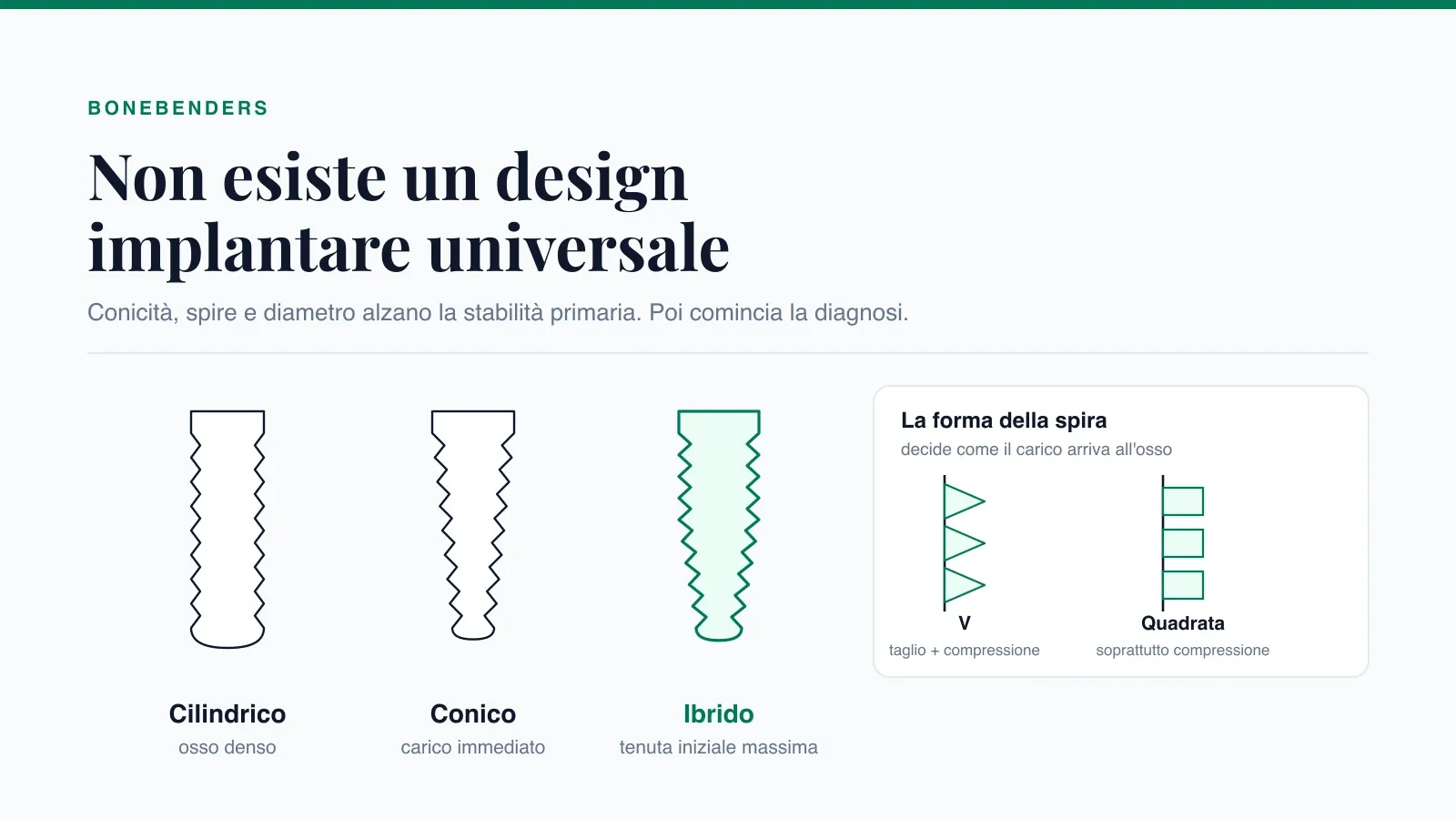
In brief — A tapered body, condensing threads and a wider diameter raise primary stability. Those are measurable numbers. Heimes (2023) closes without crowning any geometry. The factors shift with the site and the patient.
“Which implant do you use?”
Colleagues ask me that all the time when they see my cases. Of course I use my preferred implant.
Heimes, Becker, Pabst and coworkers reviewed body shape, length, diameter and threads in the International Journal of Implant Dentistry in 2023. They close by listing local and systemic factors that drive the choice. No shape crowned. For an implant-design paper, that ending is rare.
I have already written what body shape, length, diameter and threads do to initial hold. Here I care about the next step: how to use those numbers without turning them into catalog faith.
What actually raises initial hold
Primary stability is friction. Compression between titanium and bone — or at least compression at some points of the interface. You read it on the ratchet. Macrogeometry decides where and how much you compress, and keeps micromotion under the threshold beyond which the body drops osseointegration and builds you a fibrous capsule instead.
Start with body shape, because that difference shows up during insertion. Tapered implants anchor through lateral and vertical compression; cylinders dump static friction along the long axis, toward the apex. In the series Heimes collected, the ranking for primary stability is clear: hybrids first, then tapered, then cylindrical. Hsueh and colleagues measured it on polyurethane models: if a bone-level taper reaches about 29 Ncm, under the same conditions a standard cylinder stops at 8–9. Shape alone can triple insertion torque. For immediate loading, that gap decides whether you load now or wait.
Length raises stability up to about 12 mm. Beyond that, hold does not climb. At the other end, across ten RCTs in the ITI consensus, short implants (≤ 6 mm) survive at 96% versus 98% for “long” ones at one to five years. Short implants remain a solid alternative to some grafts.
Many studies put mechanical stress at the implant neck. Could that feed some crestal resorption? How?
In the posterior, two unfriendly conditions stack. Masticatory forces more than 300% higher than in other sectors, and bone quality often mediocre in the maxilla. Once length is enough, diameter matters more. Heimes notes that wider diameters raise contact surface a lot at equal length. And there is more. Thread design can multiply that surface up to three hundred times.
Then the threads themselves. Wide V and square profiles dump less stress into surrounding bone than thin squares. Very deep threads compromise vascular supply to the bone that reaches the bottom of the flute — tap the bed so you do not crush the tissue.
How much the thread alone weighs showed up in a 2024 split-mouth RCT. Barbosa and colleagues, in twenty patients and at equal hydrophilic surface, compared perforating-only threads with perforating plus condensing ones. At insertion: ISQ 63.6 (perforating and condensing) versus 40.6 (perforating only), torque 36.9 versus 28 Ncm. The advantage was still there at ninety days.
The ITI Consensus 2018, cited in the same review, records satisfactory three-year marginal bone levels for both tapered and non-tapered implants. What the shape alone means long term is still unclear. It may be irrelevant.
In 2025 Marcantonio and colleagues randomized, in a multicenter split-mouth design, two different macrostructures (cylindrical vs hybrid) in thirty patients with edentulous mandibles, under full-arch prostheses loaded within twenty-four hours. At two years: survival 99.16% and 100%. Crestal bone and clinical parameters overlapping. Two very different geometries, same outcome.
In dense bone, Heimes reports via Staedt, different lengths and diameters produce statistically indistinguishable primary stability. Where bone already holds, aggressive geometry buys little or nothing extra. The real difference shows up in softer bone.
The cost of too hard a grip
The more macrogeometry bites, the higher the torque climbs.
Dodo, Senna, Del Bel Cury and Meirelles worked in vitro on bovine rib blocks: high-torque insertions score thread crests and shed titanium particles right against crestal cortical bone. I have written about high insertion torque and what it costs the surface. Personally, I think a great deal of it comes down to implant macrogeometry.
References
- Heimes D, Becker P, Pabst A, Smeets R, Kraus A, Hartmann A, et al. How does dental implant macrogeometry affect primary implant stability? A narrative review. Int J Implant Dent. 2023;9(1):20. doi:10.1186/s40729-023-00485-z. PMID: 37405709.
- Barbosa PP, Oliveira VXR, Goulart JV, Margonar R, Moura MB, Oliveira GJPL. Effect of different thread configurations on hydrophilic implant stability. A split-mouth RCT. Braz Dent J. 2024;35:e245632. doi:10.1590/0103-6440202405632. PMID: 38537016.
- Marcantonio ACM, de Oliveira GJPL, Tassi PA, Manfrinato JPL, Segnini B, de Souza Bezerra Araújo RF, et al. Full-arch prostheses supported by implants with different macrostructures: A multicenter randomized controlled trial. Clin Implant Dent Relat Res. 2025;27(1):e13392. doi:10.1111/cid.13392. PMID: 39360638.
- Dodo C, Senna PM, Del Bel Cury AA, Meirelles L. Impact of high insertion torque on implant surface integrity. Clin Implant Dent Relat Res. 2025;27(2):e70030. doi:10.1111/cid.70030. PMID: 40200410.
- Hsueh PY, Yamaguchi Y, Yajima Y. Effect of insertion load on insertion torque value. J Dent Sci. 2025;20(3):1861-1868. doi:10.1016/j.jds.2025.03.029. PMID: 40654426.
FAQ
Tapered implants give higher primary stability. Why does the ITI Consensus say both shapes are fine?
Does a longer implant always mean more initial hold?
Do short implants really perform like longer ones?
Do aggressive threads rescue type IV bone?
Does high torque mean safer osseointegration?
Cite this article
Ready for theses, slides and papers. If you cite it on a web page, make the URL a link so readers can reach the source.
Bruschi E. There is no universal implant design [Internet]. Frosinone (Italy): Bonebenders; 2026 [cited 2026 Sep 27]. Available from: https://bonebenders.com/en/blog/implant-macrogeometry-no-universal-design/ Bruschi, E. (2026, August 11). There is no universal implant design. Bonebenders. https://bonebenders.com/en/blog/implant-macrogeometry-no-universal-design/
@misc{bruschi2026implant,
  author       = {Bruschi, Ernesto},
  title        = {There is no universal implant design},
  year         = {2026},
  month        = aug,
  howpublished = {Bonebenders},
  url          = {https://bonebenders.com/en/blog/implant-macrogeometry-no-universal-design/},
  note         = {Accessed 2026-09-27}
} Go deeper
Espansione crestale (split crest) →Allargare la cresta senza trapianto — tecnica ERE e bonebending
Need a professional opinion?
Book an appointment at Dr. Bruschi's practice in Frosinone. First visit includes full diagnosis and personalised treatment plan.
Stai valutando un impianto dentale?
Ho scritto una guida in 8 capitoli che spiega tutto quello che un paziente dovrebbe sapere prima di sedersi in poltrona. Niente marketing — solo fatti, casi studio e una checklist per fare le domande giuste.
Scarica la guidaStay Updated
New articles on periodontology, implantology and oral surgery — delivered to your inbox.
Comments
Loading comments...
Leave a comment