My dental implant feels loose: what it means and what to do
Leggi in Italiano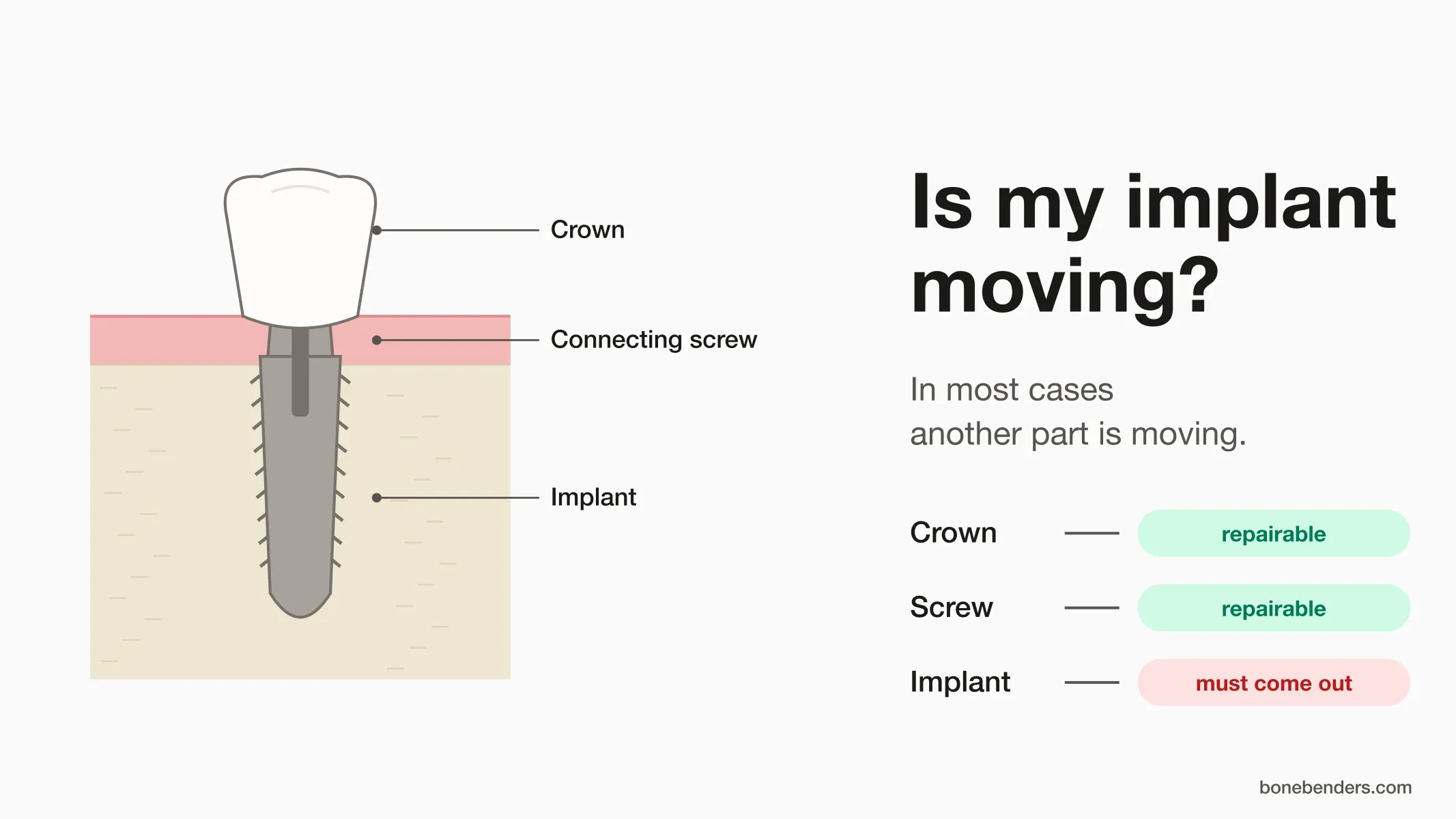
In brief — In most cases what you feel moving is the crown or the screw that holds it, and it is fixed in a single visit. If the implant itself is moving inside the bone, osseointegration is lost and the implant has to come out. A visit with an X-ray within a few days tells the two apart. Until then: no fingers, no chewing on that side, no antibiotics on your own.
First question: what is actually moving?
An implant is three parts. The titanium screw inside the bone, which we call the implant or fixture. The abutment, which comes up through the gum. The crown, the tooth you see. The abutment locks onto the implant with a small connecting screw. The crown is fixed to the abutment with cement or with that same screw.
When a patient tells me “doctor, my implant is moving”, in the great majority of cases one of the other two parts is moving.
Jung and colleagues measured this in Clinical Oral Implants Research in 2012: 46 studies, single crowns on implants followed for an average of five years. The implants were still in place in 97.2% of cases. Over the same period the connecting screw had loosened in 8.8% of crowns and 4.1% had lost retention, meaning the crown had de-cemented. One crown in ten, within five years, has a mechanical problem caused by a loosened internal screw, with the implant perfectly integrated underneath.
You can gather a few clues yourself, with your tongue and a light touch, without forcing anything.
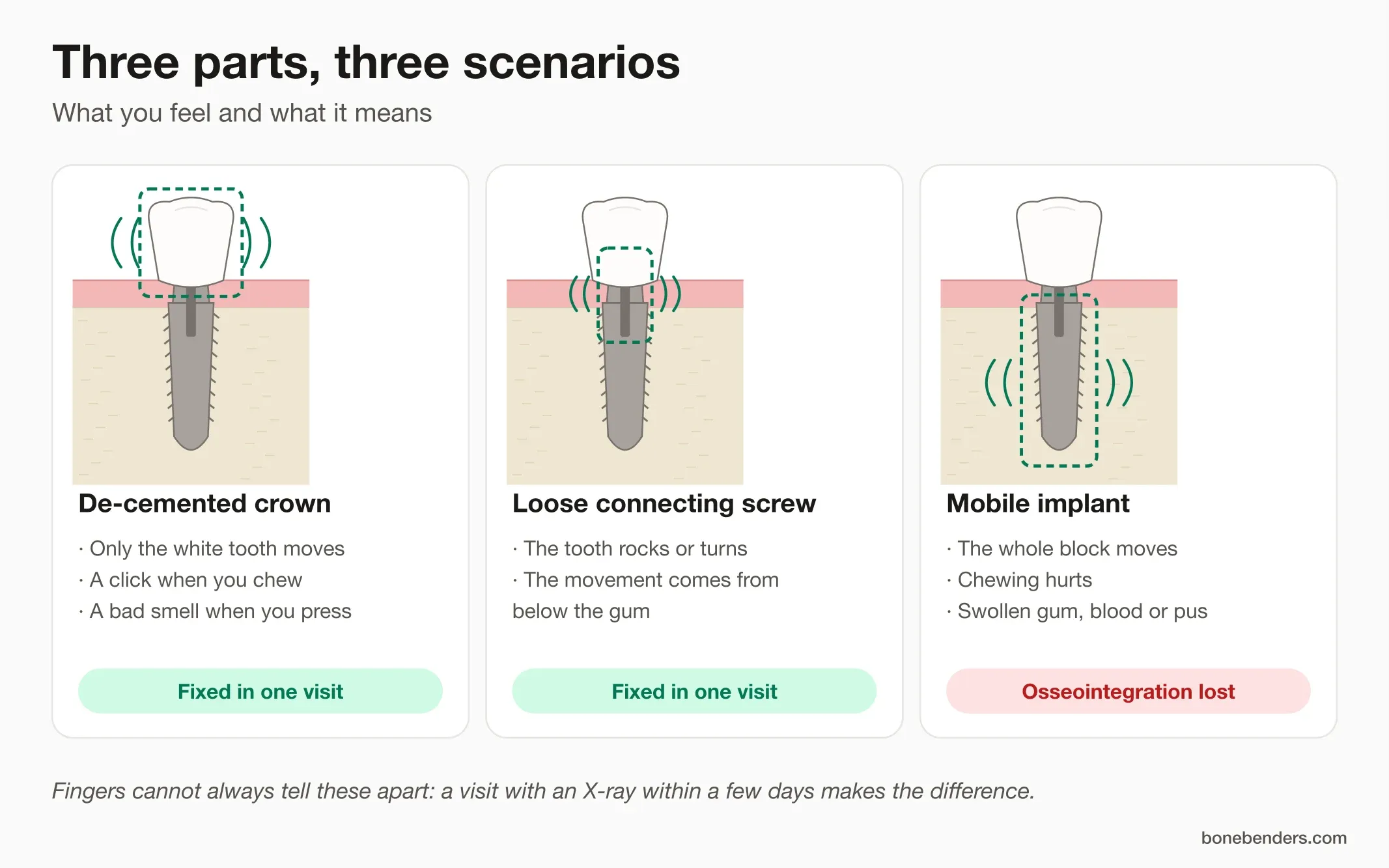
- Only the white tooth moves, perhaps with a click when you chew or an unpleasant smell when you press on it. That is a de-cemented crown.
- The tooth rocks or turns slightly, and the movement seems to come from below the gum line. That is a loose connecting screw.
- The whole block moves, chewing hurts, the gum is swollen, bleeds or leaks pus. In that case, the suspicion falls squarely on the implant.
Fingers cannot always tell these apart, and that is the limit of self-diagnosis. But the logic holds. Screw and crown are mechanical systems inside the implant, and they can be repaired. If the implant body is moving, osseointegration is lost, and it will not go back into place.
A recently placed implant that moves
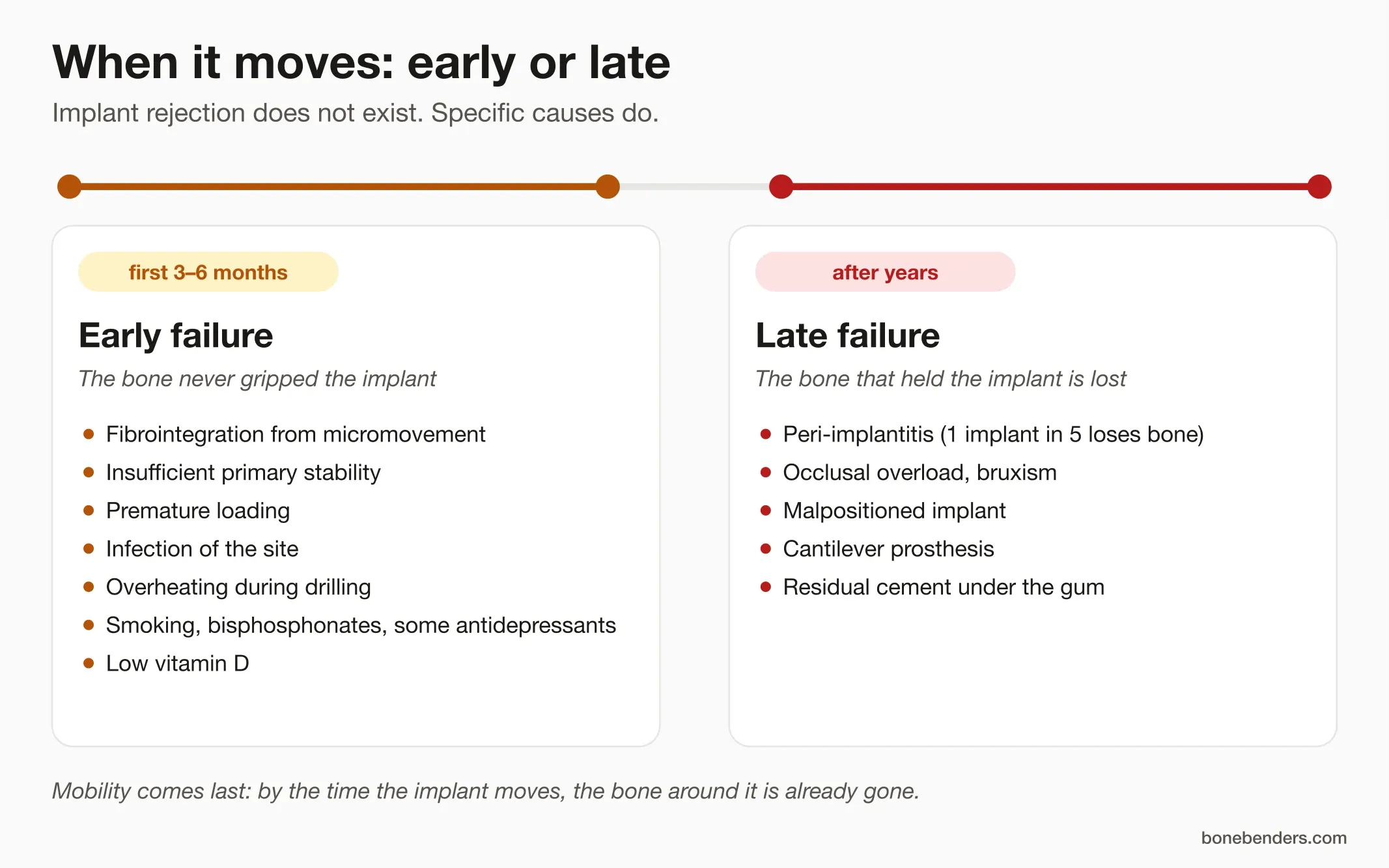
For the first three to six months the implant is doing something important. It is waiting for the bone to engulf it. If you feel it move during that window, the bone has not managed to lock it in. This is early failure, and it has specific causes.
The most frequent mechanism behind this is fibrointegration: an implant that moves even a few microns during healing pushes cells to lay down fibrous tissue instead of bone. This forms a capsule of soft tissue around the implant. The causes sit almost entirely in the first day or the first weeks of healing at the site. Insufficient primary stability in soft bone. Premature loading, a temporary that went to work too early. Infection of the site. Overheating of the bone during drilling. Smoking, which cuts the blood supply by reducing the formation of new small blood vessels. Some drugs, such as bisphosphonates or certain antidepressants, which slow bone remodelling.
Low vitamin D levels, often with secondary hyperparathyroidism, also predispose to failure.
Many patients arrive with one word in mind, “rejection”. Titanium (or rather its surface oxide, which is essentially a ceramic) is inert and the immune system ignores it. So rejection of a dental implant does not exist. What exists is osseointegration that failed to happen, with precise and largely predictable causes.
An early implant that moves comes out, almost always with a simple, non-traumatic gesture, because the bone is not holding it. Then you wait, any risk factors are reconsidered, and you start again with a new implant.
An implant that becomes loose after years
Here the picture changes. The implant had integrated, it worked for years, and at some point it started losing the bone that held it. This is late failure, and cause number one is peri-implantitis.
Derks and Tomasi, in the Journal of Clinical Periodontology in 2015, pooled 11 epidemiological studies: peri-implant mucositis (inflammation of the mucosa without bone loss) affected 43% of patients, peri-implantitis (with bone loss) 22%. And prevalence rose with years in function. One implant in five, after a few years, has already lost bone.
What you need to understand is that peri-implantitis works in silence. Bleeding when you brush, gum receding to expose the threads, a little pus, sometimes nothing at all. The 2017 World Workshop consensus (Berglundh and colleagues, 2018) keeps mobility out of the signs used to diagnose peri-implantitis, for a precise reason. By the time the implant moves, the bone around it is already gone. Mobility comes last, usually after years of quieter signals.
Other roads lead to the same place. Occlusal overload, typical of night-time grinders, which puts forces on the bone that the prosthetic connection was never designed for. A malpositioned implant, too tilted or too close to the neighbouring tooth, working off-axis. A cantilever, an unsupported extension that multiplies the lever. And residual cement. Staubli and colleagues (Clinical Oral Implants Research, 2017) reviewed 26 publications covering 945 patients with cemented crowns. In sites with peri-implant disease, excess cement under the gum was found in between 33 and 100% of cases depending on the study. A sliver of cement forgotten years earlier can be enough.
If you are wondering how long an implant should last under normal conditions, the answer with numbers is in the article on how long dental implants last. Here it is enough to say that an implant becoming loose after ten years is a rare event, and when it happens there is almost always a story behind it that a careful visit can reconstruct.
The first 48 hours: what to do, what to avoid
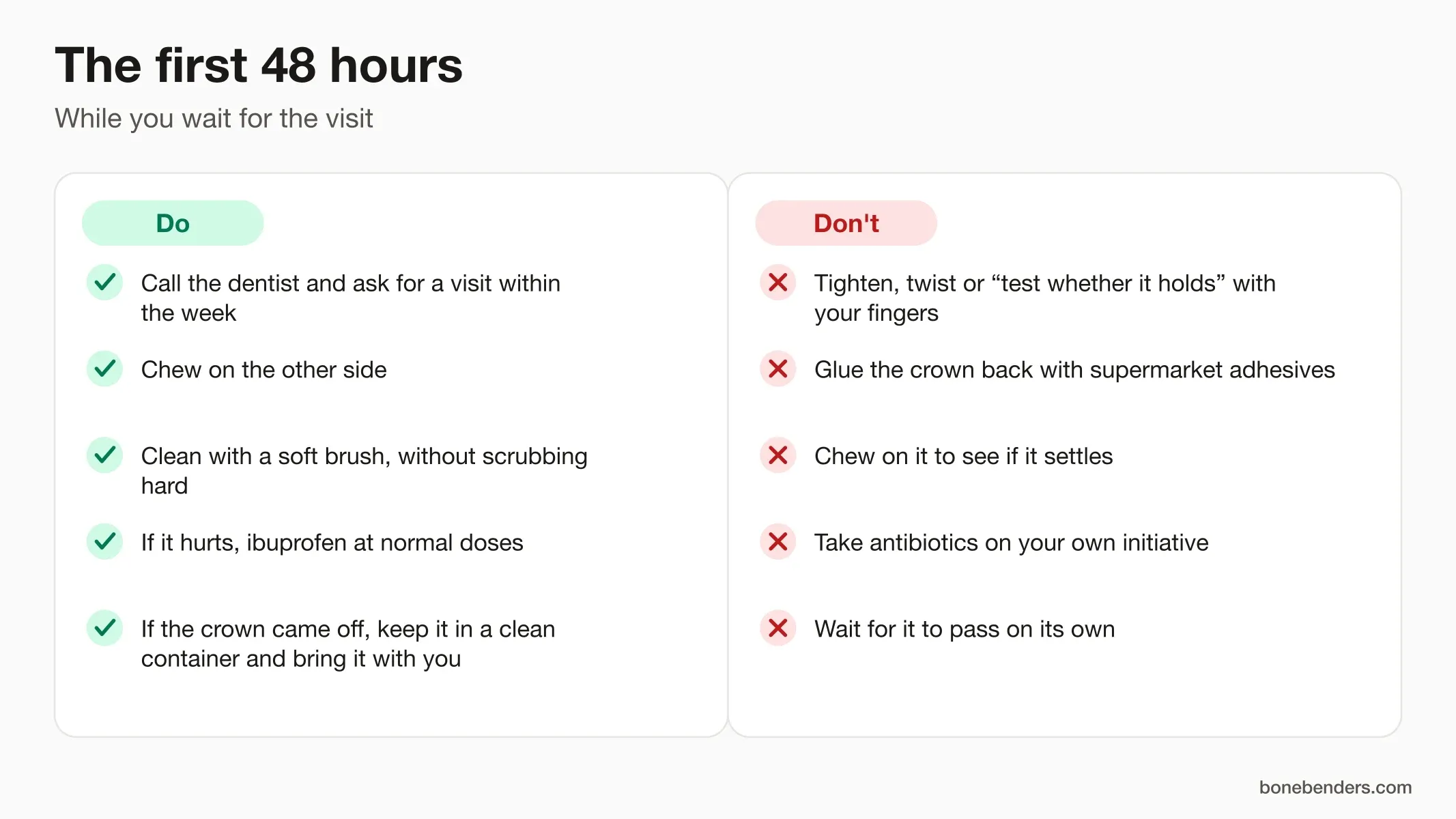
Call the dentist who placed the implant, or an oral or maxillofacial surgeon who works with implants, and ask for a visit within a few days. A visit within the week is the right timing. If the crown has come off completely, put it in a clean container and bring it with you. It can often be reused, because it has simply come off.
In the meantime chew on the other side. Clean the area with a soft brush, without scrubbing hard. If it hurts, ibuprofen at normal doses is enough.
Absolutely do not do the following:
- Do not tighten, twist or “test whether it holds” with your fingers. A loose screw that keeps working can fracture inside the implant, and a ten-minute problem becomes months of work.
- Do not glue the crown back with supermarket adhesives. I have removed crowns stuck on with cyanoacrylate, and they are hard to salvage.
- Do not chew on it to see if it settles.
- Do not take leftover antibiotics at home on your own initiative.
- Do not wait for it to pass. The screw does not retighten itself, and bone does not regrow on its own around an implant that moves. Meanwhile the gum grows back over it.
What I do at the visit
The visit takes an hour and follows a set order.
First we talk. I want to know everything about your history, dental and otherwise.
I check by eye and by palpation. I will do a mobility test on the crown and, if needed, on the abutment alone. Percussion. Probing around the implant with a periodontal probe, where indicated, to measure the pockets and see whether it bleeds or leaks pus.
Then the X-ray. A periapical film with a holder shows the threads and the bone level. In hard-to-diagnose cases, or if removal is being considered, a CBCT shows the thickness of the buccal bone wall that a periapical hides.
If the ceramic crown is screw-retained, I sometimes unscrew it and check whether the connecting screw is intact. If it is cemented, I check the abutment. Many diagnoses end here, with a new screw or simply by tightening the existing one.
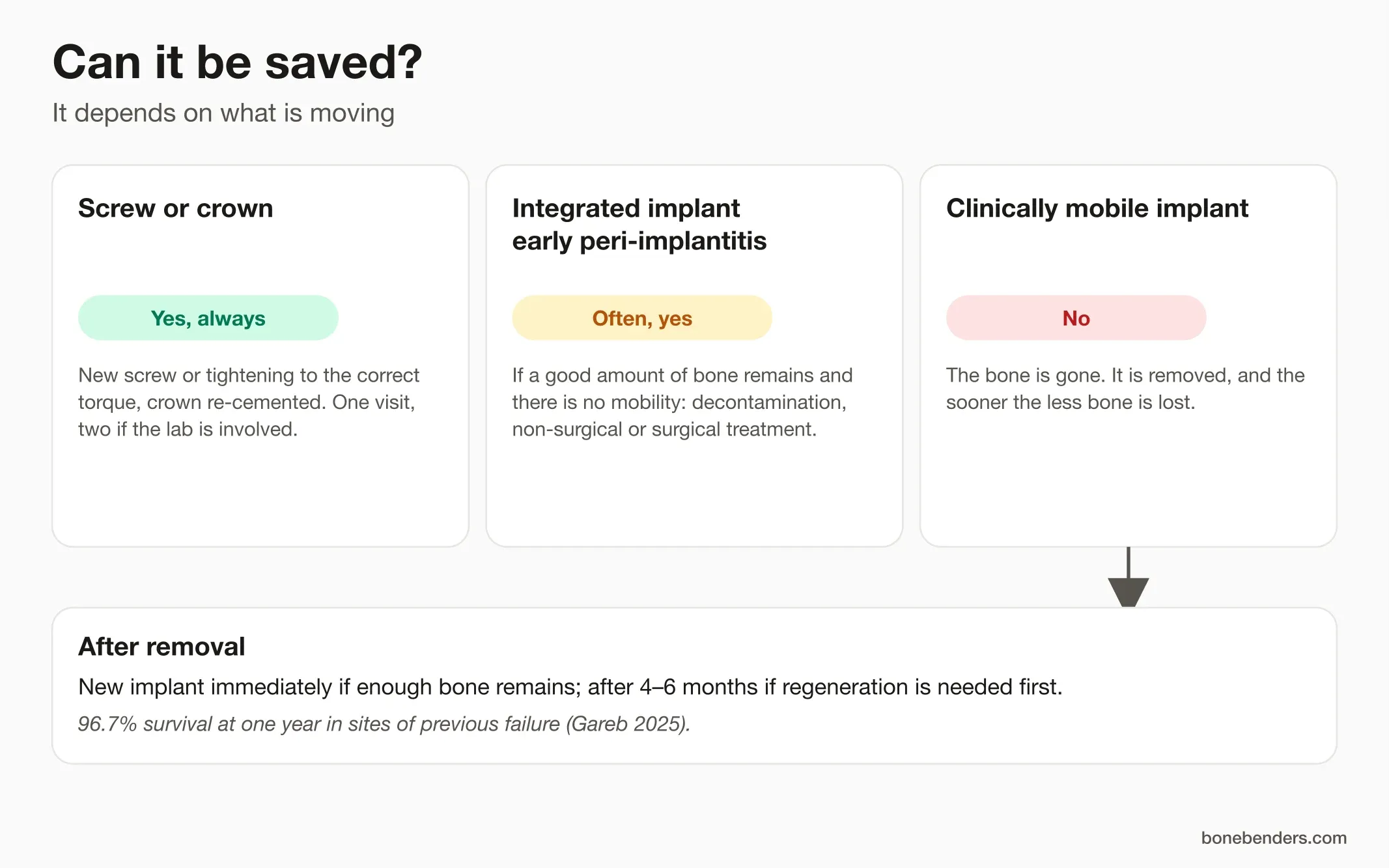
Can it be saved?
If the problem is only a loosened abutment or crown, yes, always. Tighten to the correct torque, or re-cement the crown. One visit, sometimes two if a lab step is needed.
An integrated implant with early peri-implantitis can often still be saved. If the X-ray still shows a good amount of bone and there is no clinical mobility, the surface can be decontaminated and the disease stopped. The path starts with non-surgical treatment of peri-implantitis and, if the defect is deep, reaches surgical treatment, with or without regeneration of the lost bone. It works when you act before the defect gets too deep.
A clinically mobile implant. It cannot be saved, because the bone is gone and no therapy regrows it around a surface that moves. The implant has to be removed, and the sooner it is done the less bone is lost in taking it out.
After removal there are two options. Gareb and colleagues, in the International Journal of Oral and Maxillofacial Surgery in 2025, reviewed 24 studies on implants placed where a previous one had failed: 96.7% survival at one year, with no significant difference between immediate and delayed placement. The number is excellent. And it tells us, essentially, that the second implant has an excellent chance of success and can even be placed immediately, if clinical conditions allow.
The condition for immediate placement is that enough bone remains to give the new implant stability. If it does not, the site is regenerated first and the implant placed later, once the graft has matured, usually four to six months on.
But one thing is fundamental. It is worth understanding why the first implant fell before placing another. If you already have an X-ray and a quote in hand and would like another view before deciding, a second opinion on those images is a reasonable step.
One last thing
The question “my implant is moving” almost always has a reassuring answer and a short deadline. Reassuring because in most cases it is a small internal screw that needs tightening. Short because a loose screw left to itself, or a peri-implantitis left to run, turn a simple problem into a complex one.
What I describe here is what I tell the patients who come to Studio Denti Più in Frosinone with an implant, placed here or elsewhere, that has started to move.
Dr. Ernesto Bruschi — periodontist and oral implantologist, Centro Odontoiatrico Denti Più, Frosinone, Italy. ORCID: 0000-0002-4773-5384.
Feel an implant moving and want to know what is actually moving? At Studio Denti Più in Frosinone the visit includes X-ray, probing and a check of the connecting screw in the same appointment. Call +39 0775 889009 or write us on WhatsApp.
References
-
Jung RE, Zembic A, Pjetursson BE, Zwahlen M, Thoma DS. Systematic review of the survival rate and the incidence of biological, technical, and aesthetic complications of single crowns on implants reported in longitudinal studies with a mean follow-up of 5 years. Clin Oral Implants Res. 2012;23 Suppl 6:2-21. doi:10.1111/j.1600-0501.2012.02547.x. PMID: 23062124.
-
Derks J, Tomasi C. Peri-implant health and disease. A systematic review of current epidemiology. J Clin Periodontol. 2015;42 Suppl 16:S158-S171. doi:10.1111/jcpe.12334. PMID: 25495683.
-
Berglundh T, Armitage G, Araujo MG, Avila-Ortiz G, Blanco J, Camargo PM, et al. Peri-implant diseases and conditions: consensus report of workgroup 4 of the 2017 World Workshop on the Classification of Periodontal and Peri-Implant Diseases and Conditions. J Clin Periodontol. 2018;45 Suppl 20:S286-S291. doi:10.1111/jcpe.12957. PMID: 29926491.
-
Staubli N, Walter C, Schmidt JC, Weiger R, Zitzmann NU. Excess cement and the risk of peri-implant disease - a systematic review. Clin Oral Implants Res. 2017;28(10):1278-1290. doi:10.1111/clr.12954. PMID: 27647536.
-
Gareb B, Vissink A, Terheyden H, Meijer HJA, Raghoebar GM. Outcomes of implants placed in sites of previously failed implants: a systematic review and meta-analysis. Int J Oral Maxillofac Surg. 2025;54(3):268-280. doi:10.1016/j.ijom.2024.10.006. PMID: 39490354.
FAQ
Why does a dental implant become loose?
My implant moves slightly: is that normal?
What should I do if my implant is loose?
Does a loose implant hurt?
Can an implant that becomes loose after years be saved?
If the implant is loose, is my body rejecting it?
Can a new implant be placed right after the old one is removed?
Go deeper
Espansione crestale (split crest) →Allargare la cresta senza trapianto — tecnica ERE e bonebending
Need a professional opinion?
Book an appointment at Dr. Bruschi's practice in Frosinone. First visit includes full diagnosis and personalised treatment plan.
Stai valutando un impianto dentale?
Ti hanno detto che non hai abbastanza osso, o ti hanno proposto un’arcata fissa? Ho scritto una guida di dieci pagine: le strade possibili, gli esami che servono e le dieci domande da fare prima di firmare.
Ricevi la guidaStay Updated
New articles on periodontology, implantology and oral surgery — delivered to your inbox.
Comments
Loading comments...
Leave a comment