Diabetes, Prediabetes, and Implants. No Problem. But Check Your Glycated Hemoglobin.
Leggi in Italiano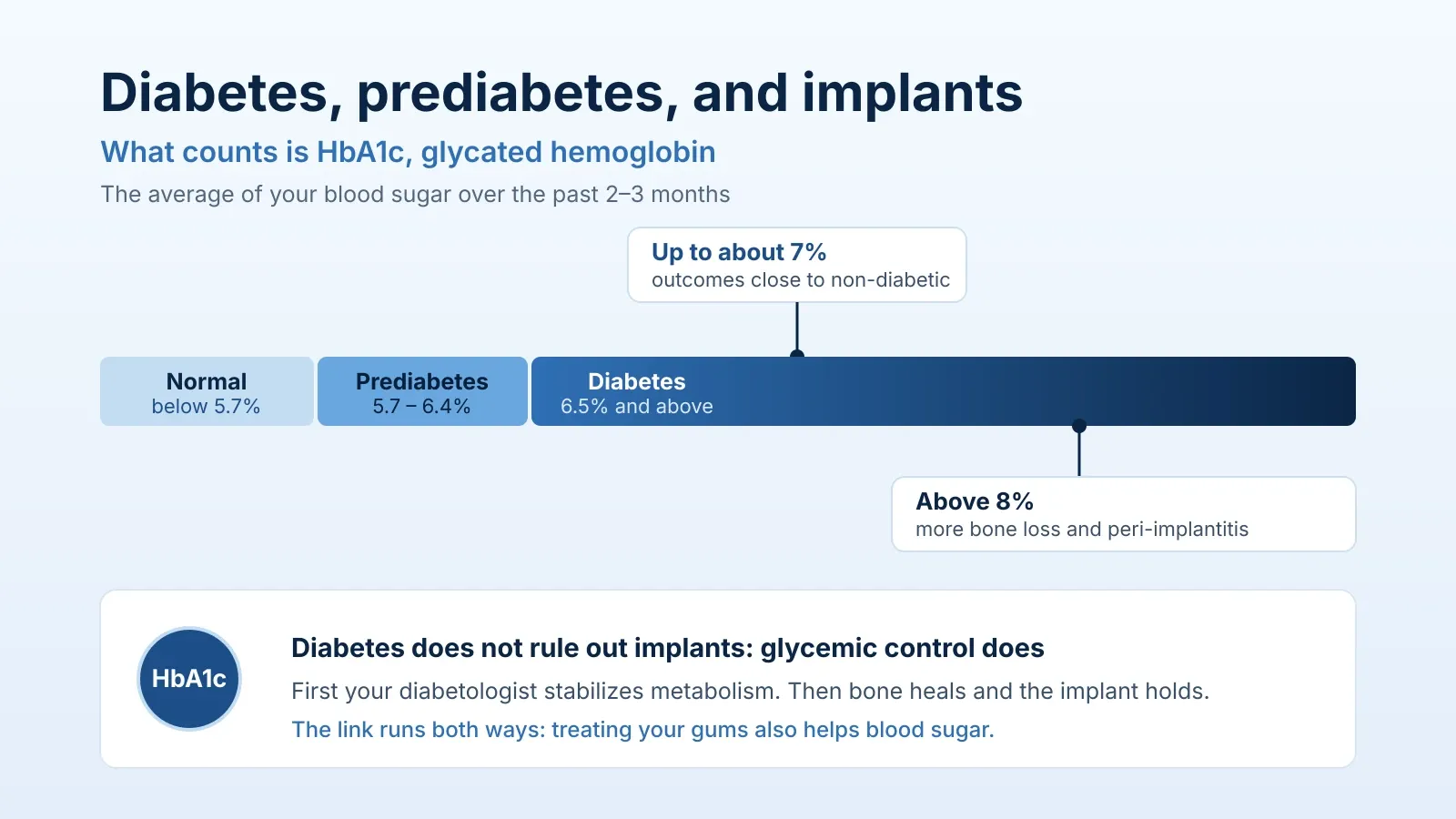
In brief — Diabetes and prediabetes do not rule out dental implants. What matters is measuring HbA1c (glycated hemoglobin): below ~7% outcomes come close to the non-diabetic; above ~8% peri-implantitis and bone loss rise. Before surgery, ask your diabetologist for an opinion.
Someone told you that with diabetes you cannot have implants.
Or someone told you the opposite, one of those who “never have failures”: “Relax, these days we do everything.” Both statements are inaccurate: biology does not care about our opinions. Possible problems are dealt with calmly, not ignored.
It is true that blood sugar out of control can slow bone healing, and not only bone healing. It is equally true that this limit, with today’s metabolic therapies, is largely surmountable.
How to handle it
“Diabetes” and “prediabetes” describe a glucose metabolism that has to be managed carefully, first of all for your general health. Your diabetologist will help you find the right therapy and a balanced diet. Correct treatment restores metabolic balance, and with it bone metabolism goes back to physiological.
Once that balance is corrected, your implants will heal well too.
I have already written about how immunity, metabolism, and medications can sit behind the — rare — implant failures. Glucose dysmetabolism is one more factor to account for.
What HbA1c (glycated hemoglobin) is
HbA1c stands for glycated hemoglobin. Hemoglobin is the red-cell protein that carries oxygen. When sugar circulates in excess, part of it binds durably to that protein. By measuring how “sugared” it is, you get an estimate of glycemic control over the past two to three months — not of the morning you skipped breakfast.
That is why I use it in some cases of implant planning. A single day’s fasting glucose may not give you the full picture of your metabolic balance.

The numbers: what recent reviews say about this risk factor
Bencze and colleagues (University of Budapest), in 2024 in the Journal of Dentistry, lined up 35 studies and 1,761 people in a broad systematic review of the literature (DOI: 10.1016/j.jdent.2024.105094). Blunt question: in adults with implants, do those with type 2 diabetes or prediabetes have worse peri-implant conditions than those without?
The result is clear-cut: prediabetes and poorly controlled diabetes yes; well-controlled diabetes no. Mean crestal bone loss was about 1.2 mm higher in prediabetes, 1.8 mm higher in poor control, and only 0.4 mm — not significant — in well-controlled patients. In meta-regression, each additional percentage point of HbA1c corresponded to roughly 0.24 mm more crestal loss.
The 2025 AO/AAP systematic review in the Journal of Periodontology (Galarraga-Vinueza and colleagues, 102 studies — DOI: 10.1002/JPER.24-0154) places diabetes mellitus among the risk indicators for peri-implantitis, alongside periodontitis, smoking, and alcohol. Context: about one in five implant patients develops peri-implantitis; mucositis (surface inflammation without bone loss) is even more frequent. If you want to understand why the bacteria around an implant are not a copy of periodontitis, I cover it in the comparison on peri-implant microbiota.
Shahi and colleagues, in 2026 in BMC Oral Health, summarize the results of 54 studies (DOI: 10.1186/s12903-026-07782-0): implant survival in people with diabetes often stays high, above 90–95%. The price is paid elsewhere. With HbA1c above 8% you see more marginal bone loss, more probing depth, more bleeding, more inflammatory mediators. With HbA1c around or below 7% the outcomes come close to those of people without diabetes.
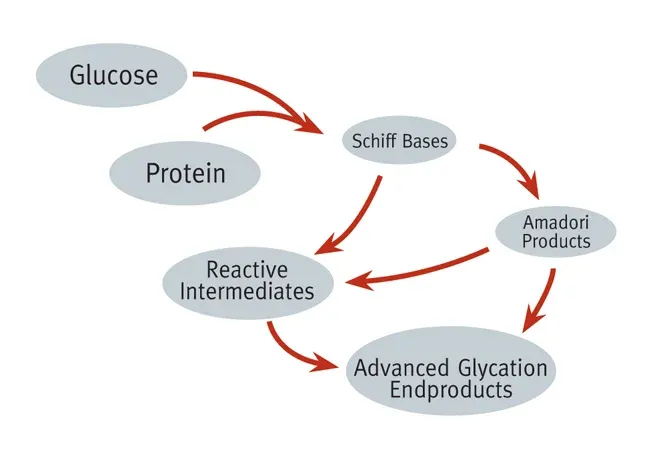
Lv and colleagues, in Clinical Oral Implants Research (2022 — DOI: 10.1111/clr.14010), add a likely mechanism: in people with diabetes, advanced glycation end products (AGEs) rise in the peri-implant crevicular fluid, together with signals that brake bone metabolism. The higher the HbA1c, the worse — in dose–response — the AGEs, the probing depth, and the bone loss.
Wagner and colleagues (2022, International Journal of Implant Dentistry — DOI: 10.1186/s40729-021-00399-8) confirm the picture: poorly controlled, more peri-implantitis and more long-term losses; controlled, similar success rates; prediabetes, a signal on peri-implant disease more than on survival alone.
Which value to watch — and why you need a diabetologist
In the literature, two thresholds keep coming back:
- around ≤ 7%: the zone where peri-implant outcomes, if hygiene and periodontal support hold, come close to the non-diabetic;
- above ~ 8%: the zone where bone loss, bleeding, and peri-implantitis risk rise repeatedly across the reviews.
Prediabetes, with HbA1c typically between 5.7% and 6.4%, is not “almost nothing.” In Bencze’s data it already weighs on keeping peri-implant bone levels.
These are thresholds to pay attention to. The decision on how to reach adequate control — drugs, diet, timing — belongs to the diabetologist, not to the oral surgeon. They are the one who will stabilize the therapy and your glucose levels. The dentist steps in after stabilization.
Maintenance
Osseointegration is not only a day-zero event: it is also continuous maintenance. High blood sugar can hinder initial osseointegration and, after healing, favor progressive bone resorption through peri-implantitis.
This is why hygiene and recalls are not educational optional extras. They are the maintenance. If you still have natural teeth with periodontitis to treat, sort that out first: a history of periodontitis is another strong peri-implant risk indicator. And if you smoke, smoking after an implant or an extraction adds a second factor that the reviews single out as a major risk.
The street runs both ways
So far we have looked at metabolism conditioning the mouth. But the traffic runs in both directions: periodontitis favors the onset of dysmetabolism, not only the other way around.
Chronic periodontal inflammation pours cytokines into the circulation and interferes with insulin signaling. The result is more insulin resistance, which is the doorway to prediabetes, type 2 diabetes, and metabolic syndrome.
The numbers: Wu and colleagues, in 2020 in BMC Oral Health, analyzed 53 studies (DOI: 10.1186/s12903-020-01180-w). In patients with periodontitis the prevalence of diabetes is about four times higher (Odds Ratio, OR 4.04), and severe periodontitis is associated with a 53% higher incidence of diabetes. It is one more chapter of the thirty-year connection between teeth and general health.
And it works the other way round too, in your favor: the 2022 Cochrane review (DOI: 10.1002/14651858.CD004714.pub4) showed that treating periodontitis lowers HbA1c by about 0.43 percentage points at three to four months. It is not a primary cure for diabetes, but it is a real contribution, obtained by treating the gums. Your diabetologist will appreciate it.
The circle closes with weight and the microbiota: oral dysbiosis reaches the gut and feeds systemic inflammation and hyperinsulinemia.
For you, in practice: if you have inflamed gums and borderline blood sugar, you also have to treat any periodontitis. It is part of the metabolic therapy. And stabilizing metabolism is part of treating the gums. Then, on ground that has been treated, implants do their work well.
Prediabetes and the danger of metabolic syndrome
In the data, prediabetes already associates with more bone loss around implants. It is also the window in which correcting course is simplest: movement, weight, diet, and — when indicated — drugs your diabetologist knows better than I do.
This is where GLP-1 comes in. GLP-1 analogues (semaglutide, liraglutide and related molecules) are not “the implant drug.” They are metabolic tools that act on insulin, appetite, and systemic inflammation, with effects on the gingival side described in the literature. If you are taking them, always tell your dentist.
What to do, concretely
- If you have blood sugar or metabolic problems, bring a recent HbA1c (glycated hemoglobin), not just “I have been diabetic for ten years.”
- If you are in the ≥ 8% zone, or if control is unstable, talk to your diabetologist first, before booking surgery. I would rather wait for a governed metabolism than salvage peri-implantitis later.
- If you have prediabetes (about 5.7–6.4%), do not file the report away. It is already a danger for your implants, existing and future.
References
- Bencze B, Cavalcante BGN, Romandini M, et al. Prediabetes and poorly controlled type-2 diabetes as risk indicators for peri-implant diseases: a systematic review and meta-analysis. J Dent. 2024;146:105094. DOI · PMID 38788918
- Galarraga-Vinueza ME, Pagni S, Finkelman M, Schoenbaum T, Chambrone L. Prevalence, incidence, systemic, behavioral, and patient-related risk factors and indicators for peri-implant diseases: an AO/AAP systematic review and meta-analysis. J Periodontol. 2025;96(6):587-633. DOI · PMID 40489307
- Shahi S, Jalali P, Jabbari S, Qarebigloo A. Dental implant outcomes in patients with diabetes mellitus: a systematic review. BMC Oral Health. 2026;26(1):1277. DOI · PMID 42177496
- Lv X, Zou L, Zhang X, Zhang X, Lai H, Shi J. Effects of diabetes/hyperglycemia on peri-implant biomarkers and clinical and radiographic outcomes in patients with dental implant restorations: a systematic review and meta-analysis. Clin Oral Implants Res. 2022;33(12):1183-1198. DOI · PMID 36251562
- Wagner J, Spille JH, Wiltfang J, Naujokat H. Systematic review on diabetes mellitus and dental implants: an update. Int J Implant Dent. 2022;8(1):1. DOI · PMID 34978649
- Andrade CAS, Paz JLC, de Melo GS, Mahrouseh N, Januário AL, Capeletti LR. Survival rate and peri-implant evaluation of immediately loaded dental implants in individuals with type 2 diabetes mellitus: a systematic review and meta-analysis. Clin Oral Investig. 2022;26(2):1797-1810. DOI · PMID 34586502
- Wu CZ, Yuan YH, Liu HH, et al. Epidemiologic relationship between periodontitis and type 2 diabetes mellitus. BMC Oral Health. 2020;20(1):204. DOI · PMID 32652980
- Simpson TC, Clarkson JE, Worthington HV, et al. Treatment of periodontitis for glycaemic control in people with diabetes mellitus. Cochrane Database Syst Rev. 2022;4(4):CD004714. DOI · PMID 35420698
FAQ
With diabetes or prediabetes, are implants off the table?
What is HbA1c, and which value should you watch before an implant?
If the implant "holds," why are you telling me about peri-implantitis?
Does prediabetes really count, or is it just an alarm on the lab report?
I am taking a GLP-1 drug (semaglutide, liraglutide…). Does that change anything?
Can treating your gums improve your blood sugar?
Aren't these meta-analyses mixing studies too heterogeneous to decide on my case?
Cite this article
Ready for theses, slides and papers. If you cite it on a web page, make the URL a link so readers can reach the source.
Bruschi E. Diabetes, Prediabetes, and Implants. No Problem. But Check Your Glycated Hemoglobin. [Internet]. Frosinone (Italy): Bonebenders; 2026 [cited 2026 Oct 25]. Available from: https://bonebenders.com/en/blog/diabetes-prediabetes-dental-implants-hba1c/ Bruschi, E. (2026, July 26). Diabetes, Prediabetes, and Implants. No Problem. But Check Your Glycated Hemoglobin. Bonebenders. https://bonebenders.com/en/blog/diabetes-prediabetes-dental-implants-hba1c/
@misc{bruschi2026diabetes,
  author       = {Bruschi, Ernesto},
  title        = {Diabetes, Prediabetes, and Implants. No Problem. But Check Your Glycated Hemoglobin.},
  year         = {2026},
  month        = jul,
  howpublished = {Bonebenders},
  url          = {https://bonebenders.com/en/blog/diabetes-prediabetes-dental-implants-hba1c/},
  note         = {Accessed 2026-10-25}
} Go deeper
Espansione crestale (split crest) →Allargare la cresta senza trapianto — tecnica ERE e bonebending
Need a professional opinion?
Book an appointment at Dr. Bruschi's practice in Frosinone. First visit includes full diagnosis and personalised treatment plan.
Stai valutando un impianto dentale?
Ti hanno detto che non hai abbastanza osso, o ti hanno proposto un’arcata fissa? Ho scritto una guida di dieci pagine: le strade possibili, gli esami che servono e le dieci domande da fare prima di firmare.
Ricevi la guidaStay Updated
New articles on periodontology, implantology and oral surgery — delivered to your inbox.
Comments
Loading comments...
Leave a comment