Guest Editor for the Journal of Functional Biomaterials: send me the papers that report the failures
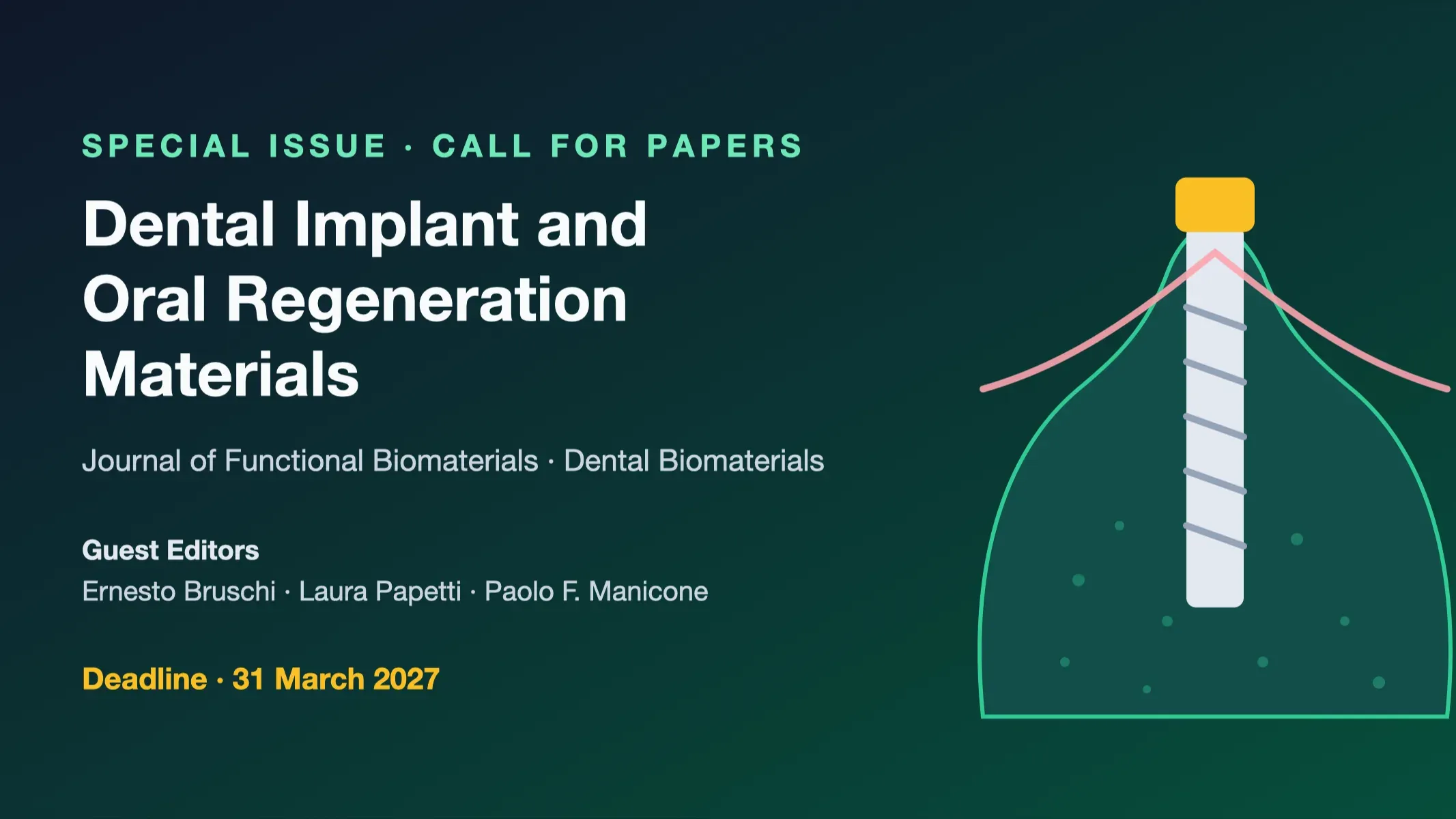
In brief — I am Guest Editor, with Laura Papetti and Prof. Paolo Francesco Manicone of the Gemelli University Hospital, of a Special Issue of the Journal of Functional Biomaterials on materials for dental implants and oral regeneration. We want long follow-ups, clinical series that report failures next to successes, and reviews that state clearly where the evidence is scarce. Manuscripts are accepted until 31 March 2027.
95% at ten years is routine success for many, but the problem has moved
In 2019 Howe, Keys and Richards pooled, in the Journal of Dentistry, the studies with ten years of follow-up on modern implants: survival of 96.4%, dropping to 93.2% when only the studies at lower risk of bias were weighted. A titanium implant placed in healthy bone by decent hands integrates. On this point the consensus is fairly broad.
The questions are elsewhere. How much bone is left around the first thread after five years? Does the soft tissue seal the implant neck, or leave it open to the attack of bacterial plaque? Derks and Tomasi, in their 2015 epidemiological review in the Journal of Clinical Periodontology, estimated a mean prevalence of peri-implantitis as high as 22% of patients, with a range across studies from 1% to 47%. Taking the mean, one implant in five survives but gets sick. Survival on its own, though, says little about what the patient actually gets.
Those considerations are where the Special Issue I was asked to edit begins.
What it is, and with whom
The Journal of Functional Biomaterials is published by the Multidisciplinary Digital Publishing Institute (MDPI) in Basel. It is a journal devoted to biomaterials, indexed in PubMed, Scopus and Web of Science, with an impact factor of 5.9 in 2025. The Special Issue is called Development, Application and Progress of Dental Implant and Oral Regeneration Materials and sits in the Dental Biomaterials section. Three of us run it. Dr Laura Papetti and Prof. Paolo Francesco Manicone work in the Division of Oral Surgery and Implantology of the Gemelli University Hospital, Università Cattolica in Rome, and bring their substantial academic experience in implant prosthodontics.
Manuscripts are accepted until 31 March 2027. Original articles, reviews and short communications, single-anonymised peer review. Publication is continuous, as each paper is accepted.
Eight topics for one large subject
The call for papers lists eight areas:
- Implant surfaces and macro-design, in relation to early stability and marginal bone remodelling.
- Graft materials.
- Membranes.
- Ridge preservation after extraction.
- Materials for ridge expansion and augmentation.
- Medical devices for regeneration.
- Abutment materials and surface topography, in relation to peri-implant soft-tissue attachment.
- Instrumental, material and substance-related determinants of peri-implantitis, and its management.
The thread that holds them together is the interface. Bone, implant and soft tissue. These biological and technological parts form one integrated system, and the materials we care about are the ones that keep it stable over years, not over six months. I have written more than once about primary stability and thread design, and about the biological seal between zone A and zone B. The Special Issue asks whoever holds data to put them on the table.
What I would like to read
Materials reach the market faster than the evidence for them accumulates. A new bone substitute launches with one animal study and a series of twelve cases at six months, and borrows the rest of its reputation from similar products that came before. The evidence is often surrogate, accumulated over time for similar materials.
My father and Agostino Scipioni published the edentulous ridge expansion technique in 1994 in the International Journal of Periodontics & Restorative Dentistry, with five years of follow-up on the cases. Twenty-nine years later Lin and colleagues pooled 25 studies and over 1,400 implants in expanded ridges: survival of 98.1%. The long data held. Quite a few products launched in between with three months of follow-up and a promising title no longer exist.
So the call says clearly what we want.
- Prospective studies, or well-conducted retrospective ones, with long follow-ups.
- Documented clinical series that report failures next to successes, with an explanation of why.
- Reviews, narrative or systematic, that say without detours where the evidence is thin.
- Negative or unexpected findings. A material that disappointed, described well, saves a hundred colleagues from repeating the mistake.
If you have twenty cases with two failures and can explain what happened, I am more interested than in fifty cases with none. The second scenario usually means the failures were not counted seriously.
Open Access
MDPI uses the open access model, the same one applied by the open journals of Elsevier, Wiley and Springer. The reader-pays subscription model is, unfortunately, becoming rare. Publications are mostly paid for by the authors or by the companies that sponsor them. The papers, though, are always reviewed by independent peers: scholars with no economic or commercial tie to the journal or to the manufacturers of the materials, which guarantees the impartiality and independence of what gets published.
That is quite different from what happens with the so-called predatory journals, which publish anything for a fee. They are easy to recognise. They are not indexed.
The journal I am working with is indexed where it matters (PubMed included) and the impact factor is above.
The worth of a Special Issue, though, also depends on who edits it, and that is why I said yes. The filter is the three of us. A manuscript with six months of follow-up and conclusions wider than its data goes back, politely, with a letter explaining what is missing. I have refereed for years for Clinical Implant Dentistry and Related Research and BMC Oral Health, and the yardstick is the same.
If that sounds like a risk for your paper, it is the right risk.
What changes for the patients treated in my practice
A patient who reads this far wonders what it has to do with their mouth. It matters because reading studies on materials before they reach the market, and sending back the ones that promise more than they prove, is the same filter I use to choose materials and drugs for the practice. A material that is too new will wait for the data that only time shows.
Dr. Ernesto Bruschi — periodontist and implantologist, Centro Odontoiatrico Denti Più, Frosinone, Italy. Guest Editor of the Special Issue “Development, Application and Progress of Dental Implant and Oral Regeneration Materials”, Journal of Functional Biomaterials (MDPI). ORCID: 0000-0002-4773-5384.
Cover image: author’s own graphic.
References
-
Bruschi E, Papetti L, Manicone PF (Guest Editors). Special Issue “Development, Application and Progress of Dental Implant and Oral Regeneration Materials”. J Funct Biomater (MDPI), Dental Biomaterials section. Manuscript deadline 31 March 2027. mdpi.com. Accessed 11 September 2026.
-
Howe MS, Keys W, Richards D. Long-term (10-year) dental implant survival: a systematic review and sensitivity meta-analysis. J Dent. 2019;84:9-21. DOI: 10.1016/j.jdent.2019.03.008. PMID: 30904559.
-
Derks J, Tomasi C. Peri-implant health and disease. A systematic review of current epidemiology. J Clin Periodontol. 2015;42 Suppl 16:S158-71. DOI: 10.1111/jcpe.12334. PMID: 25495683.
-
Scipioni A, Bruschi GB, Calesini G. The edentulous ridge expansion technique: a five-year study. Int J Periodontics Restorative Dent. 1994;14(5):451-9. PMID: 7751111.
FAQ
What is a Special Issue, and what does a Guest Editor do?
Why an MDPI journal? Aren't those the ones where you pay to publish?
Do you accept case series and retrospective studies?
Does the paper have to be about a specific material or implant brand?
Which article types can I submit?
What does this change for a patient?
References
Cite this article
Ready for theses, slides and papers. If you cite it on a web page, make the URL a link so readers can reach the source.
Bruschi E. Guest Editor for the Journal of Functional Biomaterials: send me the papers that report the failures [Internet]. Frosinone (Italy): Bonebenders; 2026 [updated 2026 Sep 11; cited 2026 Sep 20]. Available from: https://bonebenders.com/en/blog/guest-editor-jfb-special-issue-dental-implant-materials/ Bruschi, E. (2026, September 11). Guest Editor for the Journal of Functional Biomaterials: send me the papers that report the failures. Bonebenders. https://bonebenders.com/en/blog/guest-editor-jfb-special-issue-dental-implant-materials/
@misc{bruschi2026guest,
  author       = {Bruschi, Ernesto},
  title        = {Guest Editor for the Journal of Functional Biomaterials: send me the papers that report the failures},
  year         = {2026},
  month        = sep,
  howpublished = {Bonebenders},
  url          = {https://bonebenders.com/en/blog/guest-editor-jfb-special-issue-dental-implant-materials/},
  note         = {Accessed 2026-09-20}
} Go deeper
Espansione crestale (split crest) →Allargare la cresta senza trapianto — tecnica ERE e bonebending
Need a professional opinion?
Book an appointment at Dr. Bruschi's practice in Frosinone. First visit includes full diagnosis and personalised treatment plan.
Stai valutando un impianto dentale?
Ho scritto una guida in 8 capitoli che spiega tutto quello che un paziente dovrebbe sapere prima di sedersi in poltrona. Niente marketing — solo fatti, casi studio e una checklist per fare le domande giuste.
Scarica la guidaStay Updated
New articles on periodontology, implantology and oral surgery — delivered to your inbox.
Comments
Loading comments...
Leave a comment