Primary Stability and Implant Macrogeometry
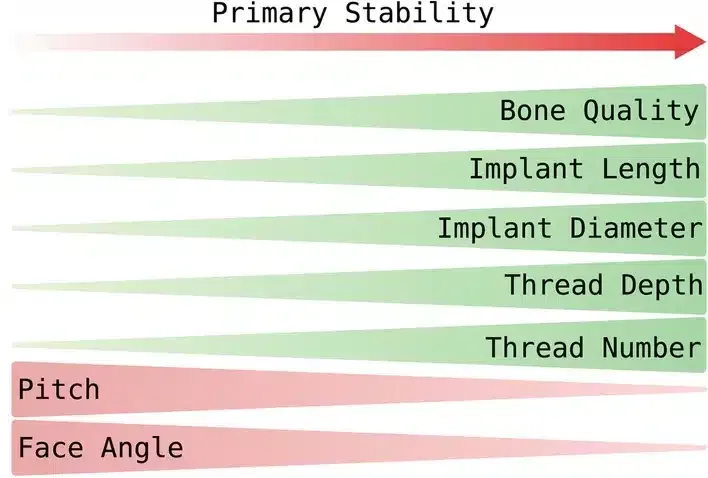
In brief — Implant macrogeometry (shape, length, diameter, threads) critically influences primary stability. Conical implants show superior stability to cylindrical; optimal length <12 mm; larger diameter improves load distribution; V/square threads reduce bone stress. High torque is not free: chase stability, not Ncm.
This has nothing to do with Pythagoras. Primary stability is one of the key factors for success in dental implantology. A recent article in the International Journal of Implant Dentistry examined in detail how the macrogeometric features of implants influence this initial stability.
But what is macrogeometry?
It is the macroscopic shapes that characterise the implant — something entirely different from the microscopic surface features of the same fixture.
According to the review by Heimes et al. (2023), implant macrogeometry includes:
- Implant body shape (cylindrical vs conical)
- Implant length
- Implant diameter
- Thread design
Body shape
The implant body shape varies widely, and the market is crowded with mixed forms. See the figure below.
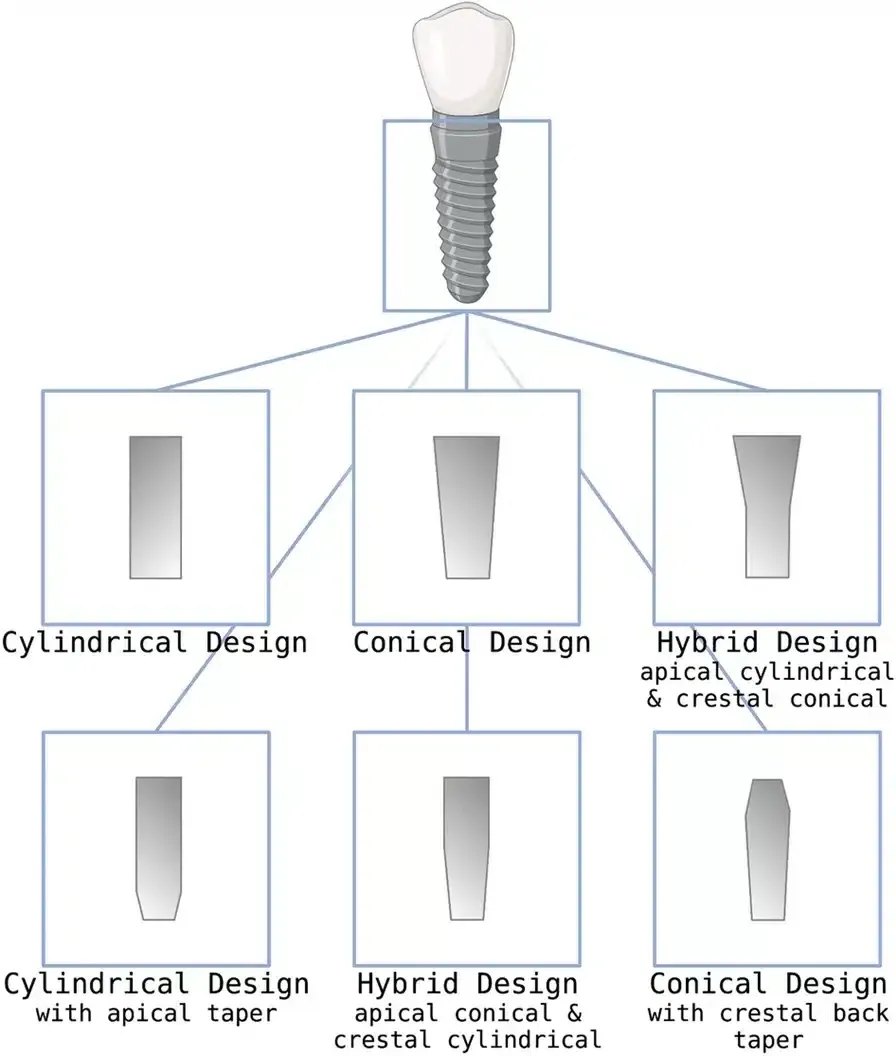
Given this, the classic split into cylindrical and conical implants is not universally applicable, though it remains a useful first-order distinction.
Conical implants show superior primary stability compared with cylindrical ones, because they:
- Distribute lateral forces better onto the cortical bone
- Create greater, more progressive bone compression during insertion
- Are especially suited to immediate loading protocols
This is not theory. Nascimento et al. (2024, Oral and Maxillofacial Surgery) measured deformation and torque during insertion in D2-density synthetic bone: conical implants require a higher insertion torque than cylindrical ones and — a detail few report — distribute stress better, while some machined cylindrical implants actually cracked the bone during seating. Hsueh et al. (2025, Journal of Dental Sciences) confirmed the gap with hard numbers: under matched conditions, a conical bone-level implant generated around 29 Ncm against the 8-9 Ncm of a standard cylinder. Body shape alone can triple primary stability. That is why, in protocols that engage the apex early, conicality is not a flourish — it is a prerequisite. The same logic runs through implant shape innovation.
Implant length
The relationship between length and primary stability is linear up to 12 mm. Beyond that, added length brings no meaningful improvement in initial stability.
Implant diameter
A larger diameter:
- Increases the bone-implant contact area
- Improves load distribution
- Matters most in posterior regions with high occlusal loads
- Is not the devil — no one has ever shown that large diameters cause more problems
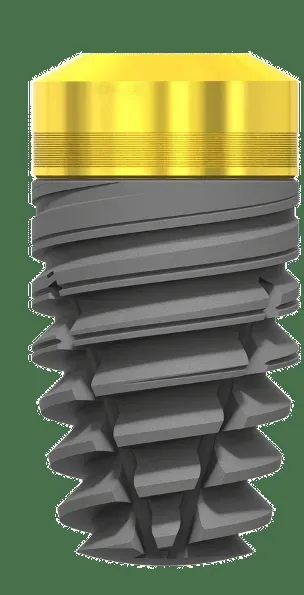
The systematic review by Kreve et al. (2024, Oral and Maxillofacial Surgery) sets the record straight: among all macroscopic features, it is the balance between compressive and tensile stress that decides osseointegration, not a single number. Diameter counts because it enlarges the contact area, but it must be read together with the bone quality of the site, never in isolation.
Thread design
Threads with the following features favour primary stability:
- Depth: 0.34-0.5 mm
- Width: 0.18-0.3 mm
- Pitch: above 0.8 mm
- Profile: V-shaped and square threads reduce stress on the bone
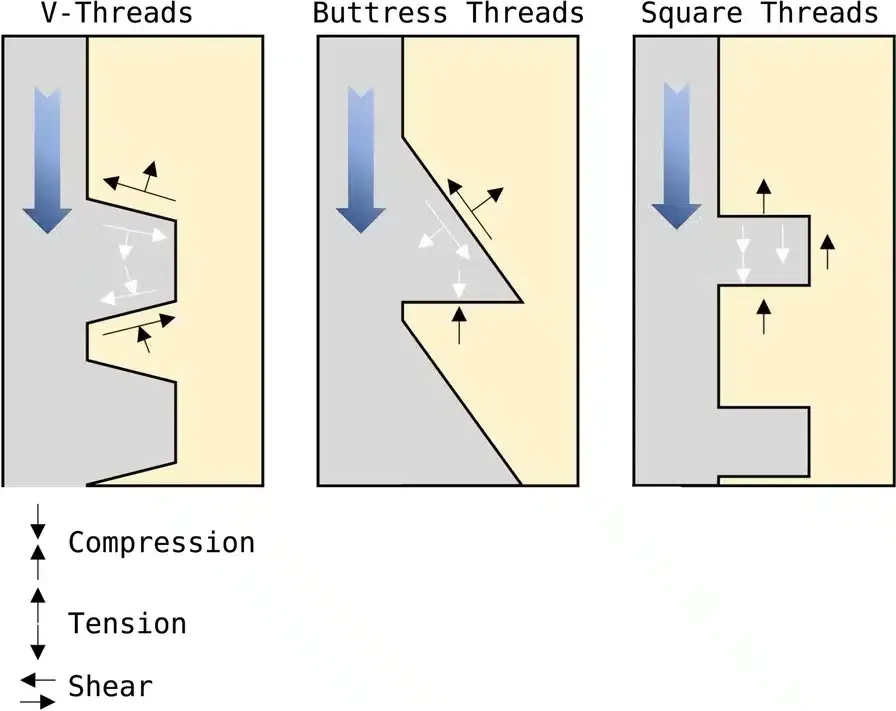
Here the clinical evidence is sturdier than people assume. Barbosa et al. (2024, Brazilian Dental Journal) compared two thread configurations on the same patient in a split-mouth RCT: hybrid threads — perforating plus condensing — produced a markedly higher ISQ already at insertion (63 vs 41) and held it through 90 days. The trapezoidal profile, in Nascimento’s (2024) tests, demands more torque than the triangular one: a sign it bites the bone harder. The thread is not a cosmetic detail of the design. It is where the implant decides how much bone to compress.
A caveat on torque
The more aggressive the macrogeometry, the higher the torque it generates. And here honesty is due: high torque is not free. Dodo et al. (2025, Clinical Implant Dentistry and Related Research) showed that high-torque insertions damage the thread crests and release titanium particles right at the crestal cortical bone — a possible cofactor in marginal bone loss. This is not an argument against conical bodies or deep threads. It is an argument against the idea that more Ncm is always better. Macrogeometry exists to win stability without strangling the bone, not to win a tightening contest. Which is also why, before falling in love with a shape, it is worth remembering why smooth implants stopped convincing anyone: it is the geometry, not the smooth surface, that does the work — the same theme behind the conical vs flat connection debate.
Clinical recommendations
The authors suggest choosing implant macrogeometry according to:
- Bone quality at the receiving site
- Dense bone: cylindrical or standard conical implants
- Poor-quality bone: conical implants with aggressive threads
- Loading protocol
- Immediate loading: prefer conical implants with double threads
- Anatomical site
- Aesthetic zone: conical implants for lower perforation risk
- Posterior regions: consider larger diameters
Conclusions
The choice of implant macrogeometry should not be random but based on a careful assessment of local and systemic patient factors. As the review highlights, there is no single “universal” optimal design: selection must be personalised for every clinical situation.
References
- Heimes D, Becker P, Pabst A, Smeets R, Kraus A, Hartmann A, et al. How does dental implant macrogeometry affect primary implant stability? A narrative review. Int J Implant Dent. 2023;9(1):20. DOI: 10.1186/s40729-023-00485-z · PMID: 37405709
- Kreve S, Ferreira I, da Costa Valente ML, Dos Reis AC. Relationship between dental implant macro-design and osseointegration: a systematic review. Oral Maxillofac Surg. 2024;28(1):1-14. DOI: 10.1007/s10006-022-01116-4 · PMID: 36171302
- Nascimento LRXC, Torelly GM, Elias CN. Measurement of bone deformation and insertion torque during dental implant installation. Oral Maxillofac Surg. 2024;29(1):19. DOI: 10.1007/s10006-024-01294-3 · PMID: 39661169
- Barbosa PP, Oliveira VXR, Goulart JV, Margonar R, Moura MB, Oliveira GJPL. Effect of different thread configurations on hydrophilic implant stability. A split-mouth RCT. Braz Dent J. 2024;35:e245632. DOI: 10.1590/0103-6440202405632 · PMID: 38537016
- Hsueh PY, Yamaguchi Y, Yajima Y. Effect of insertion load on insertion torque value. J Dent Sci. 2025;20(3):1861-1868. DOI: 10.1016/j.jds.2025.03.029 · PMID: 40654426
- Dodo C, Senna PM, Del Bel Cury AA, Meirelles L. Impact of high insertion torque on implant surface integrity. Clin Implant Dent Relat Res. 2025;27(2):e70030. DOI: 10.1111/cid.70030 · PMID: 40200410
FAQ
Are conical implants always superior to cylindrical ones?
What is the optimal implant length for stability?
Does a larger implant diameter always guarantee better results?
Which thread features favour primary stability?
Should I always pick conical implants with aggressive threads?
References
- https://doi.org/10.1186/s40729-023-00485-z
- https://doi.org/10.1007/s10006-022-01116-4
- https://doi.org/10.1007/s10006-024-01294-3
- https://doi.org/10.1590/0103-6440202405632
- https://doi.org/10.1016/j.jds.2025.03.029
- https://doi.org/10.1111/cid.70030
- https://pubmed.ncbi.nlm.nih.gov/37405709/
- https://pubmed.ncbi.nlm.nih.gov/36171302/
- https://pubmed.ncbi.nlm.nih.gov/39661169/
- https://pubmed.ncbi.nlm.nih.gov/38537016/
- https://pubmed.ncbi.nlm.nih.gov/40654426/
- https://pubmed.ncbi.nlm.nih.gov/40200410/
Cite this article
Ready for theses, slides and papers. If you cite it on a web page, make the URL a link so readers can reach the source.
Bruschi E. Primary Stability and Implant Macrogeometry [Internet]. Frosinone (Italy): Bonebenders; 2025 [updated 2026 Jun 10; cited 2026 Sep 20]. Available from: https://bonebenders.com/en/blog/implant-design-primary-stability/ Bruschi, E. (2025, July 2). Primary Stability and Implant Macrogeometry. Bonebenders. https://bonebenders.com/en/blog/implant-design-primary-stability/
@misc{bruschi2025implant,
  author       = {Bruschi, Ernesto},
  title        = {Primary Stability and Implant Macrogeometry},
  year         = {2025},
  month        = jul,
  howpublished = {Bonebenders},
  url          = {https://bonebenders.com/en/blog/implant-design-primary-stability/},
  note         = {Accessed 2026-09-20}
} Go deeper
Espansione crestale (split crest) →Allargare la cresta senza trapianto — tecnica ERE e bonebending
Need a professional opinion?
Book an appointment at Dr. Bruschi's practice in Frosinone. First visit includes full diagnosis and personalised treatment plan.
Stai valutando un impianto dentale?
Ho scritto una guida in 8 capitoli che spiega tutto quello che un paziente dovrebbe sapere prima di sedersi in poltrona. Niente marketing — solo fatti, casi studio e una checklist per fare le domande giuste.
Scarica la guidaStay Updated
New articles on periodontology, implantology and oral surgery — delivered to your inbox.
Comments
Loading comments...
Leave a comment