BNC2: How the Periosteum Wakes Up Stem Cells After a Fracture
Leggi in Italiano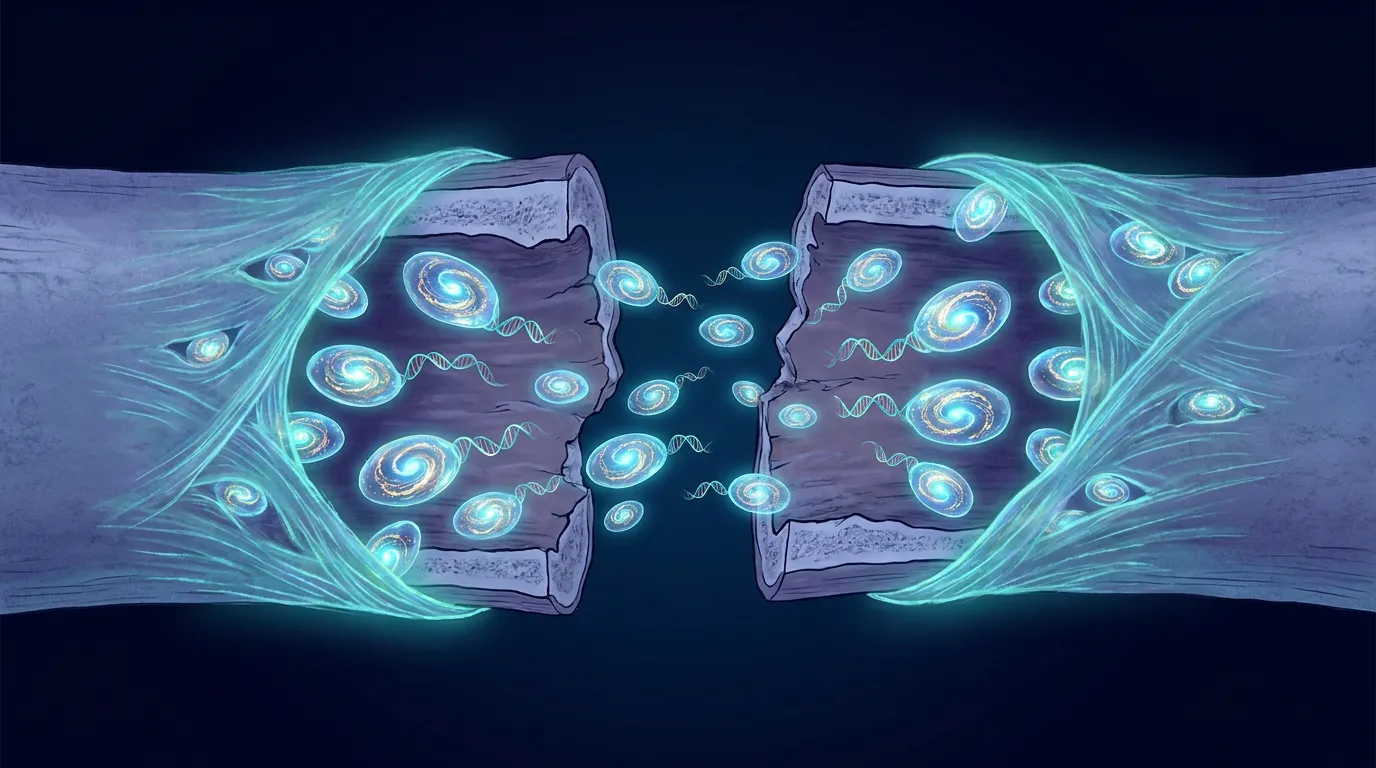
5-10% of fractures don’t heal as they should. A study in EMBO Journal explains why — and opens the door to a pharmacological solution.
Nearly all fractures heal. The injured body orchestrates a biological sequence — first comes “inflammation”, a very broad term that can mean a range of biological events, from immunology to regeneration. Then the bony callus forms. And finally (hopefully) mineralisation occurs through remodelling — restoring structural integrity to the bone within weeks.
Between 5 and 10% of fractures develop a condition known as nonunion (Zura et al., 2016). The bone fails to consolidate as it should. The callus doesn’t mature properly. The fracture sits there, open or half-open, not fully ossified. In certain anatomical sites — femoral neck in the elderly, scaphoid of the wrist — the percentage climbs higher. The cost is steep: chronic pain, revision surgery, bone grafts, external fixators.
The question orthopaedic research has been carrying for decades is simple to ask. The answer is not. Why do some fractures heal and others don’t? What distinguishes, at the molecular or macroscopic level, a bone that repairs itself from one that gives up?
A study published in 2025 in EMBO Journal offers an answer. And the answer has a name: BNC2.
The periosteum is not a passive wrapper
Understanding the discovery starts with the periosteum — that much-maligned layer of connective tissue wrapped around the outer surface of bones. Anyone who thinks of it as mere packaging is wrong. The periosteum is a reservoir of skeletal stem cells (SSCs), held in quiescence during normal life and ready to activate if and when damage arrives.
These are the cells that, after a fracture, proliferate, migrate to the injury site and differentiate into osteoblasts — which form bone — and chondrocytes — which form the soft callus of the initial phase. Periosteal stem cells are the protagonists of bone healing. Without them, no repair.
But what wakes them? And why does the wake-up call sometimes fail?
BNC2: the guardian that becomes the director
Zhang et al. (2025), from Hainan Medical University and the Chinese Academy of Sciences, identified the responsible party in a transcription factor called BNC2 (Basonuclin-2) — a zinc-containing protein barely studied in the skeletal field until this work.
Three discoveries, nested inside each other.
Under normal conditions, BNC2 is found in quiescent periosteal cells. It’s the guardian keeping them on standby — ready but silent. After a fracture, BNC2 production surges: from simple guardian it becomes an important metabolic director, driving clonal expansion of SSCs and endochondral ossification — the sequence through which the soft bony callus transforms into mature bone.
What happens when BNC2 is absent? The researchers tested it with a specific deletion in Prx1+ periosteal cells. The result is unambiguous: fracture healing stalls. Stem cells don’t proliferate. Endochondral ossification stops. The picture matches nonunion precisely.
One detail makes the finding even more precise. Deleting BNC2 in mature osteoblasts (Ocn-Cre) does not compromise healing. Deleting it in bone marrow stem cells (LepR-CreER) doesn’t either. It is specifically the loss of BNC2 in periosteal cells that causes failure. The periosteum, not the marrow. The surface stem cells, not the deep ones.
How it works: BNC2 opens the DNA
The mechanism is epigenetic. And here the research becomes elegant.
Using ATAC-seq — a technique that measures how “open” and available DNA is to transcription factors — the researchers showed that without BNC2 the promoter regions of cell proliferation genes become more closed, less accessible. Chromatin shuts down. The instructions for repairing bone are there, written in the genome, but no one can read them.
BNC2 physically interacts with the NuRD complex (Nucleosome Remodeling and Deacetylase), a large protein complex that regulates histone H3 acetylation — effectively modifying the three-dimensional structure of DNA in chromosomes. Put simply: BNC2 is a molecular door-opener. It “folds” the DNA so that the regions promoting ossification become more available for reading. In other words, after the fracture it activates and unlocks the sections of DNA containing the repair instructions. Without it, those doors stay shut.
The stem cells are there. The instructions are there. But the lock is jammed.
The pharmacological key: HDAC inhibitors
This is where things get clinically interesting.
If BNC2 works through the NuRD complex, and NuRD operates via histone deacetylation, then inhibiting HDAC enzymes (histone deacetylases) should — at least in part — compensate for the absence of BNC2. The researchers tested it: administering an HDAC1/2 inhibitor in mice lacking BNC2 in periosteal cells partially rescued fracture healing.
Partially. Not completely. But the signal is there.
Why does this matter? Three reasons. HDAC inhibitors are already an established drug class — vorinostat and romidepsin are approved for certain haematological malignancies, and their safety profile is well characterised. Trichostatin A, a pan-HDAC inhibitor, has already demonstrated pro-osteogenic effects in animal models, improving osseointegration of titanium implants in osteoporotic rats through the AKT/Nrf2 pathway (Zhou et al., 2023). And selective inhibitors for HDAC1 and HDAC2 already exist, with potentially greater selectivity and fewer systemic side effects than pan-HDAC inhibitors.
This opens the prospect of a pharmacological therapy — local or systemic — capable of unblocking healing in nonunion fractures by acting directly on the chromatin of periosteal stem cells.
What’s missing: from basic research to the clinic
We need to be honest about where we stand. This is a mouse study. The road from mouse to patient is long, and it doesn’t always reach its destination.
The open questions are many. Is BNC2 underexpressed in human nonunions? No one has checked yet — that would be the natural next step. Which drug formulation? A systemic HDAC inhibitor carries real risks: haematological toxicity, long-term neoplastic risk. A local formulation will probably be needed — an injectable hydrogel at the fracture site, for instance. Are there genetic variants of BNC2 associated with difficult healing? Pharmacogenetics in orthopaedics is still in its infancy.
In the meantime, the established pillars of nonunion management remain valid: adequate mechanical stabilisation, treatment of modifiable risk factors — smoking, diabetes, malnutrition, osteoporosis — teriparatide in selected cases (Chandran et al., 2024), shockwave therapy, bone grafts.
Why this research matters — even for those who place implants
Three reasons, and one directly concerns implant dentistry.
BNC2 identifies a specific target for nonunions. Not a blanket action on bone formation, but a mechanism confined to the cells responsible for repair after fracture. Precision, not carpet-bombing.
The study explains why the periosteum matters so much — and why it should be preserved. Surgeons in traumatology and oral surgery often sacrifice the periosteum without a second thought. Knowing that its stem cells have specific molecular requirements — active BNC2, accessible chromatin — should give pause.
Every split-thickness flap that preserves the periosteum increases the reserve of regenerative capacity that could make the difference.
And the connection with implant dentistry exists, even if indirect. If HDAC inhibitors improve osseointegration in osteoporotic models (Zhou et al., 2023) and simultaneously unblock fracture healing through periosteal chromatin, the logical thread is clear: epigenetics is not an academic topic. It’s a clinical lever. And clinicians placing implants in compromised bone may, one day, benefit from it.
References
- Zhang Z, Zhang L, Jiang B, Chen S, Xing W, Wang P, et al. Basonuclin-2 promotes fracture repair through NuRD-dependent chromatin remodeling in periosteal stem cells. EMBO J. 2025;45(4):1060-1076. doi:10.1038/s44318-025-00664-1. PMID: 41429959.
- Shi F, Yuan G, Wu Z, Luo Z, Chen Z, Liu Q, et al. Identification and function of periosteal skeletal stem cells in skeletal development, homeostasis, and disease. J Orthop Translat. 2025;51:177-186. doi:10.1016/j.jot.2025.01.010. PMID: 40160808.
- Zhou Z, Jiang W, Yan J, Liu H, Ren M, Li Y, et al. Trichostatin A enhances the titanium rods osseointegration in osteoporotic rats by the inhibition of oxidative stress through activating the AKT/Nrf2 pathway. Sci Rep. 2023;13(1):22967. doi:10.1038/s41598-023-50108-1. PMID: 38151509.
- Chandran M, Akesson KE, Javaid MK, Harvey N, Blank RD, Brandi ML, et al. Impact of osteoporosis and osteoporosis medications on fracture healing: a narrative review. Osteoporos Int. 2024;35(8):1337-1358. doi:10.1007/s00198-024-07059-8. PMID: 38587674.
- Zura R, Xiong Z, Einhorn T, Watson JT, Ostrum RF, Prayson MJ, et al. Epidemiology of fracture nonunion in 18 human bones. JAMA Surg. 2016;151(11):e162775. doi:10.1001/jamasurg.2016.2775. PMID: 27603155.
FAQ
What is BNC2 and what role does it play in bone healing?
What happens if BNC2 is missing?
How many fractures fail to heal (nonunion)?
Are there drugs that can compensate for the lack of BNC2?
Cite this article
Ready for theses, slides and papers. If you cite it on a web page, make the URL a link so readers can reach the source.
Bruschi E. BNC2: How the Periosteum Wakes Up Stem Cells After a Fracture [Internet]. Frosinone (Italy): Bonebenders; 2026 [cited 2026 Oct 16]. Available from: https://bonebenders.com/en/blog/bnc2-periostio-cellule-staminali-frattura/ doi:10.5281/zenodo.23052266
Bruschi, E. (2026, May 23). BNC2: How the Periosteum Wakes Up Stem Cells After a Fracture. Bonebenders. https://doi.org/10.5281/zenodo.23052266
@misc{bruschi2026bnc2,
  author       = {Bruschi, Ernesto},
  title        = {BNC2: How the Periosteum Wakes Up Stem Cells After a Fracture},
  year         = {2026},
  month        = may,
  howpublished = {Bonebenders},
  url          = {https://bonebenders.com/en/blog/bnc2-periostio-cellule-staminali-frattura/},
  doi          = {10.5281/zenodo.23052266},
  note         = {Accessed 2026-10-16}
} Go deeper
Espansione crestale (split crest) →Allargare la cresta senza trapianto — tecnica ERE e bonebending
Need a professional opinion?
Book an appointment at Dr. Bruschi's practice in Frosinone. First visit includes full diagnosis and personalised treatment plan.
Stai valutando un impianto dentale?
Ti hanno detto che non hai abbastanza osso, o ti hanno proposto un’arcata fissa? Ho scritto una guida di dieci pagine: le strade possibili, gli esami che servono e le dieci domande da fare prima di firmare.
Ricevi la guidaStay Updated
New articles on periodontology, implantology and oral surgery — delivered to your inbox.
Comments
Loading comments...
Leave a comment