Integrin Beta-1: The Key to Porphyromonas Invasion
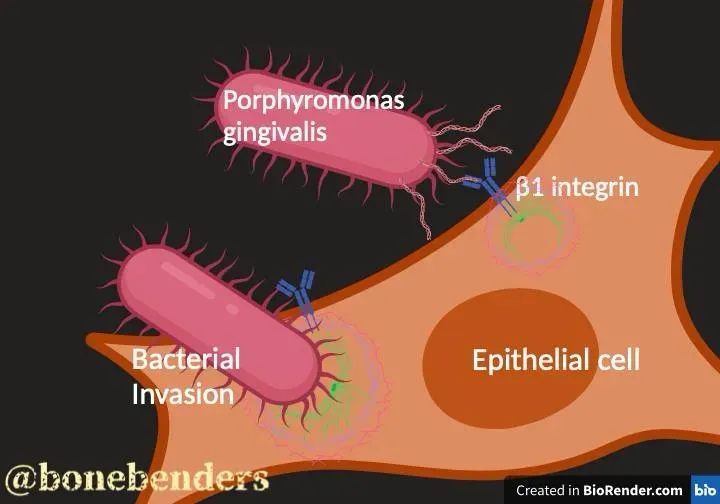
In brief — Porphyromonas gingivalis, the keystone pathogen of periodontitis, doesn’t just sit in the pocket: it gets inside our cells. Its fimbrial adhesin FimA latches onto integrin beta-1 (CD29) on the host membrane, triggers a cytoskeletal rearrangement, and is swallowed whole — the cell helps its own invader in. A 2025 study confirmed the FimA → integrin β1 mechanism directly; other recent work shows that blocking the fimbriae stops much of the damage, and that the bug’s enzymes travel far beyond the gums.
Let’s use the usual example: Porphyromonas gingivalis (PG).
PG is a classic opportunistic pathogen — more precisely a pathobiont — of the gingival pockets in periodontal disease, and it attacks the host’s cells partly through its fimbriae.
Bacterial fimbriae are thin, filament-like extensions found on the surface of many bacteria. These structures, visually similar to microscopic hairs, are fundamental to bacterial biology.
Fimbriae originate from the cytoplasmic membrane and measure between 0.2 and 2 µm in length. They are rigid, cylindrical structures built from a protein called pilin, which organises itself into helical arrangements.
At the free end of the fimbria sit a variable number of other proteins, the adhesins. Each has its own peculiar shape, complementary to structures on the cells of other living organisms: these adhesins are the mechanism by which the bacterium can stick to the host’s cells, and then invade them directly.
This is crucial for colonisation and infection. In some cases the fimbriae also help bacteria move toward nutrients or escape harmful substances. In Porphyromonas gingivalis, the fimbriae let the pathobiont travel even inside cells it has already invaded, and slip from one cell to the next.
The point of attack — the Trojan horse — that lets the fimbriae of Porphyromonas gingivalis grab the host’s cells is integrin beta-1 (β1), on the cell surface.
Integrin beta-1, also known as CD29, is a cell-surface protein with a central role in the interactions between cells and the extracellular matrix (ECM). It belongs to the integrin family — heterodimers made of two subunits, one alpha and one beta. Integrin beta-1 can pair with several alpha subunits, forming integrin complexes that act as receptor-transmitters for various ECM components, such as collagen and fibronectin.
Integrins, beta-1 included, take part in several biological processes:
1) Cell adhesion: integrins anchor cells to the ECM, letting them hold their position and resist mechanical forces.
2) Signal transduction: when integrins bind to other ECM proteins, they pass biochemical signals into the cell. This regulates functions such as proliferation, migration and differentiation.
Sometimes that binding, and the signalling that follows, is the first step of a direct bacterial assault. That’s exactly what happens with PG: integrin beta-1 on the host cell surface recognises the adhesins on the fimbriae.
The transduction of that fimbrial signal then drives a rearrangement of the cytoskeleton whose purpose is to internalise the bacteria into the cytoplasm. So it is the host’s own eukaryotic cells that hand the bacterial aggressor the keys.
This logic makes obvious sense for immune cells — macrophages, say — that internalise invaders in order to neutralise them.
The same thing, though, happens with cells that have far weaker defences. PG invades the gingival epithelial cells (and not only those…) — a phenomenon I’ve also covered in the good and the bad of the oral microbiome — and inside them it stays alive and replicates.
For years this was a laboratory story. Then, in 2025, came the confirmation that closes the circle on integrin beta-1 itself. Huang and colleagues (Journal of Translational Medicine, 2025) isolated PG’s fimbrial protein FimA and watched it hook onto the CD151/integrin β1 (ITGB1) complex on the host membrane: from that grip a cytoskeletal rearrangement unfolds — through the JNK/paxillin pathway — identical in its logic to the one we’ve just described for the gingival cell. They saw it in carcinoma cells, where the bacterium promoted migration and metastasis. But the point isn’t oncology. The point is that the fimbria → integrin → internalisation mechanism is no quirk of the mouth: it’s a key PG uses wherever it finds the right lock.
The fimbriae, in any case, are not all alike. Alongside FimA, PG carries a second type, Mfa1, and disarming them pays off. Cao and colleagues (mSphere, 2024) built monoclonal antibodies against Mfa1 and, in an animal model of periodontitis, cut the bacterium’s adhesion to cells and — this is what counts — the loss of alveolar bone. Take the grappling hooks away from the bug, and much of the assault stalls. It’s the same logic that underpins how we treat severe periodontitis: break the chain of attack rather than chase its consequences.
Then there’s a chapter PG writes far from the mouth. Once inside, it doesn’t sit still: its most fearsome enzymes, the gingipains, are packaged and shipped out by a dedicated secretion system — the T9SS, reconstructed step by step by Lei and colleagues (Molecular Oral Microbiology, 2025) — and they also travel inside outer-membrane vesicles. These parcels are what let the bug spread its weapons at a distance. The review by Shawkatova and colleagues (Life, 2025) gathered the evidence that PG’s gingipains and LPS, once past the blood-brain barrier, feed the neuroinflammatory processes of Alzheimer’s disease. It remains an association, not a verdict. But it explains why a bacterium of the gums gets neurologists talking.
It all starts with something banal: colonisation. PG is transmitted — a kiss is enough — and it isn’t the only pathobiont that has learned to get inside our cells. The difference, as always in periodontal disease, comes down to balance: as long as the defences hold, the bacterium is just an awkward guest; when the balance breaks, it becomes an invader.
Image created with BioRender.com
References
- Huang X, Zhuang Y, Wang R, et al. Colonization by Porphyromonas gingivalis in cervical squamous cell carcinomas promotes metastasis through FimA/CD151/ITGB1 signaling. J Transl Med. 2025;23(1):1166. doi:10.1186/s12967-025-06928-y · PMID: 41136985
- Lei Z, Ma Q, Zhou X, Li Y. The secretion and maturation journey of gingipains. Mol Oral Microbiol. 2025;40(5):177-190. doi:10.1111/omi.12497 · PMID: 40490843
- Cao M, Wang S, Zhou S, et al. Development of monoclonal antibodies against Mfa1 and their protective capacity in an experimental periodontitis model. mSphere. 2024;10(1):e0072124. doi:10.1128/msphere.00721-24 · PMID: 39699191
- Shawkatova I, Durmanova V, Javor J. Alzheimer’s disease and Porphyromonas gingivalis: exploring the links. Life (Basel). 2025;15(1):96. doi:10.3390/life15010096 · PMID: 39860036
References
- https://doi.org/10.1186/s12967-025-06928-y
- https://doi.org/10.1111/omi.12497
- https://doi.org/10.1128/msphere.00721-24
- https://doi.org/10.3390/life15010096
- https://pubmed.ncbi.nlm.nih.gov/41136985/
- https://pubmed.ncbi.nlm.nih.gov/40490843/
- https://pubmed.ncbi.nlm.nih.gov/39699191/
- https://pubmed.ncbi.nlm.nih.gov/39860036/
Cite this article
Ready for theses, slides and papers. If you cite it on a web page, make the URL a link so readers can reach the source.
Bruschi E. Integrin Beta-1: The Key to Porphyromonas Invasion [Internet]. Frosinone (Italy): Bonebenders; 2024 [updated 2026 May 31; cited 2026 Sep 20]. Available from: https://bonebenders.com/en/blog/porphyromonas-gingivalis-cell-invasion/ Bruschi, E. (2024, December 7). Integrin Beta-1: The Key to Porphyromonas Invasion. Bonebenders. https://bonebenders.com/en/blog/porphyromonas-gingivalis-cell-invasion/
@misc{bruschi2024porphyromonas,
  author       = {Bruschi, Ernesto},
  title        = {Integrin Beta-1: The Key to Porphyromonas Invasion},
  year         = {2024},
  month        = dec,
  howpublished = {Bonebenders},
  url          = {https://bonebenders.com/en/blog/porphyromonas-gingivalis-cell-invasion/},
  note         = {Accessed 2026-09-20}
} Go deeper
Espansione crestale (split crest) →Allargare la cresta senza trapianto — tecnica ERE e bonebending
Need a professional opinion?
Book an appointment at Dr. Bruschi's practice in Frosinone. First visit includes full diagnosis and personalised treatment plan.
Stay Updated
New articles on periodontology, implantology and oral surgery — delivered to your inbox.
Comments
Loading comments...
Leave a comment