Bleeding after a dental implant: what's normal and what's not
Leggi in Italiano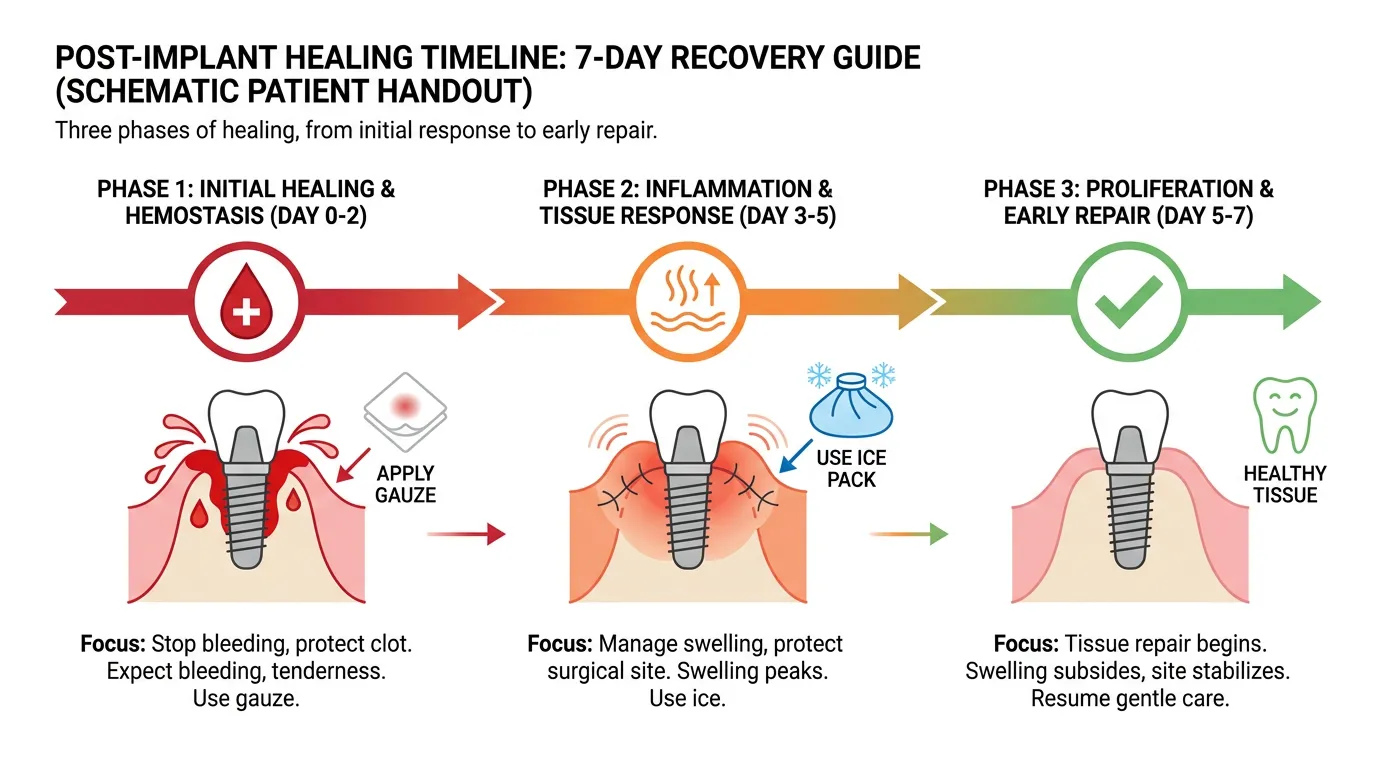
In brief — Mild blood-tinged saliva in the first 48 hours is expected and normal. Bright-red bleeding that won’t stop is not. Swelling peaks around day three and resolves within a week. Pain is managed with NSAIDs, not opioids.
Almost every patient asks the same thing walking out of the operatory: “Doctor, I’m bleeding — is that normal?”
Almost always, the answer is yes.
But “almost always” is not “always.” Knowing the difference between what is expected and what demands immediate attention is exactly what this article is for.
Bleeding in the first 24–48 hours
When I place an implant, I create a surgical wound in bone. The body responds the only way it knows: inflammation, clotting, repair.
The blood you see in the first hours is not a hemorrhage. It is oozing — a mild seepage from the traumatised tissue that colours saliva pink or pale red. It happens after any oral surgical procedure, from third-molar extractions to multi-implant placements. It lasts 24–48 hours, occasionally 72.
How to manage it: a folded sterile gauze, bitten down with light but sustained pressure for 30–60 minutes. That is usually enough. Mechanical pressure stabilises the clot.
What not to do matters just as much. Do not rinse your mouth in the first 24 hours. Do not use mouthwash — any vigorous rinsing destabilises the clot and restarts the bleeding. Do not smoke: nicotine is vasodilatory, and the negative pressure of inhalation can dislodge the clot. I have seen patients leave the practice in excellent shape, then return two hours later bleeding because they had smoked a cigarette.
Bleeding that is not normal
Different from oozing is active bright-red bleeding, heavy and unresponsive to pressure. It is not common — but it happens, and when it does it requires prompt attention.
A systematic review published in Medicina Oral analysed all documented cases of serious haemorrhage following implant placement. The highest-risk area was the mandibular canine region, where accidental perforation of the lingual cortical plate can injure the sublingual or submental artery. In those cases, bleeding is not inside the mouth — it is in the floor of the mouth or the neck, and can compromise the airway.
These are rare complications, reported in the literature as isolated case reports. But they need to be known.
Call your dentist immediately — or go to the emergency room — if:
- Bleeding does not stop after 60 minutes of continuous pressure with gauze
- The blood loss is heavy and bright red, not diluted pink
- You notice or feel swelling increasing rapidly in the floor of the mouth, tongue, or neck
- You have difficulty breathing or swallowing
- A haematoma is visibly expanding under the jaw or in the neck
Rare. But not something to wait out at home.
Swelling: three days of patience
Swelling is almost always present after an implant. It almost always frightens patients more than it should.
It is a normal inflammatory response. The body is repairing the bone tissue around the implant through the osseointegration process, recruiting cells, fluids, and mediators. That swelling is biology at work — not a problem.
It peaks between the second and third day, then slowly subsides. In most cases it has nearly resolved by days 5–7.
How to manage it:
- First 24 hours: ice pack wrapped in a cloth, never directly on skin. Cycles of 20 minutes on, 20 minutes off. Cold reduces oedema and modulates pain.
- From day three: warmth helps fluid reabsorption. A warm cloth on the cheek for 15–20 minutes, three times a day.
Bruising (ecchymoses) on the chin, neck, or — rarely — around the eyes in the days that follow is normal. These are subcutaneous haematomas that follow gravity. They turn yellow-green as haemoglobin breaks down. They reabsorb in 7–10 days. Unsightly, certainly. But normal.
Pain: the peak nobody expects
Most patients are surprised at how comfortable they feel right after surgery. The local anaesthetic holds. The real test comes 5–6 hours later, when anaesthesia wears off.
That is when the surgical trauma is fully perceived. The first 48–72 hours concentrate most of the analgesic demand.
My protocol is straightforward: ibuprofen is the first-line agent. For mild pain: 400 mg every 4–6 hours as needed. For moderate: 400–600 mg every 6 hours on a fixed schedule for the first 24 hours. Add paracetamol if needed.
I will not prescribe opioids for a routine implant placement. There is no justification for it.
Oral hygiene in the first 7 days
This is the area least explained — and the one that generates the most follow-up calls.
Day 1: no rinsing, no toothpaste on the surgical area. Brush adjacent teeth very gently with a soft brush, avoiding the operated zone entirely.
From day 2: warm saline rinses. Half a teaspoon of salt dissolved in a glass of warm water, three times a day after meals. Gently — no vigorous swishing.
From days 3–4: normal brushing of all other teeth, skirting the implant site. On the surgical area, use a soft interdental brush or a dampened gauze passed with care.
Around days 7–10, sutures are removed, or dissolve on their own depending on the type placed. After that, normal oral hygiene resumes across the full mouth without restriction.
When pain grows instead of fading
There is one simple rule in implant recovery: pain must decrease day by day. Not plateau. Not increase.
In the first two days, maximum levels are expected. From day three onward, it must come down. If pain instead increases between days 3 and 5, especially together with growing swelling, fever, or a salty unpleasant taste in the mouth — these are signs of a possible local infection. Contact your dentist without delay.
The risk of peri-implant infection is low in otherwise healthy patients but is not zero, particularly in smokers, immunocompromised individuals, or those with poorly controlled metabolic conditions.
One last thing
Thirty years of implantology have taught me that most questions in the post-operative week come from uncertainty, not from real complications. A generic instruction sheet does not cut it — patients need to understand why that bleeding is normal, how to tell it from the kind that is not, when to call and when to wait.
What I describe here is what I tell my patients at Studio Denti Più in Frosinone before they leave the practice.
Dr. Ernesto Bruschi — periodontist and oral implantologist, Centro Odontoiatrico Denti Più, Frosinone, Italy. ORCID: 0000-0002-4773-5384.
Planning a dental implant and want to know exactly what to expect? At Studio Denti Più in Frosinone you receive personalised post-operative instructions before you leave. Call +39 0775 889009 or write us on WhatsApp.
FAQ
Is it normal to bleed after a dental implant?
How long does swelling last after a dental implant?
What are the warning signs after a dental implant?
When can I resume normal toothbrushing after an implant?
References
- Balaguer-Martí JC, Peñarrocha-Oltra D, Balaguer-Martínez J, et al. Immediate bleeding complications in dental implants: a systematic review. Med Oral Patol Oral Cir Bucal. 2015;20(2):e231-8. doi:10.4317/medoral.20203 · PMID: 25475779 · free full text
- Bryce G, Bomfim DI, Bassi GS. Pre- and post-operative management of dental implant placement. Part 2: management of early-presenting complications. Br Dent J. 2014;217(4):171-176. doi:10.1038/sj.bdj.2014.702 · PMID: 25146803
- La Monaca G, Pranno N, Polimeni A, et al. Hemorrhagic Complications in Implant Surgery: A Scoping Review on Etiology, Prevention, and Management. J Oral Implantol. 2023;49(4):414-427. doi:10.1563/aaid-joi-d-22-00130 · PMID: 36796068
Cite this article
Ready for theses, slides and papers. If you cite it on a web page, make the URL a link so readers can reach the source.
Bruschi E. Bleeding after a dental implant: what's normal and what's not [Internet]. Frosinone (Italy): Bonebenders; 2026 [updated 2026 May 25; cited 2026 Oct 16]. Available from: https://bonebenders.com/en/blog/sanguinamento-dopo-impianto-dentale-primi-7-giorni/ Bruschi, E. (2026, May 25). Bleeding after a dental implant: what's normal and what's not. Bonebenders. https://bonebenders.com/en/blog/sanguinamento-dopo-impianto-dentale-primi-7-giorni/
@misc{bruschi2026sanguinamento,
  author       = {Bruschi, Ernesto},
  title        = {Bleeding after a dental implant: what's normal and what's not},
  year         = {2026},
  month        = may,
  howpublished = {Bonebenders},
  url          = {https://bonebenders.com/en/blog/sanguinamento-dopo-impianto-dentale-primi-7-giorni/},
  note         = {Accessed 2026-10-16}
} Go deeper
Espansione crestale (split crest) →Allargare la cresta senza trapianto — tecnica ERE e bonebending
Need a professional opinion?
Book an appointment at Dr. Bruschi's practice in Frosinone. First visit includes full diagnosis and personalised treatment plan.
Stai valutando un impianto dentale?
Ti hanno detto che non hai abbastanza osso, o ti hanno proposto un’arcata fissa? Ho scritto una guida di dieci pagine: le strade possibili, gli esami che servono e le dieci domande da fare prima di firmare.
Ricevi la guidaStay Updated
New articles on periodontology, implantology and oral surgery — delivered to your inbox.
Comments
Loading comments...
Leave a comment