Afraid of the Dentist? Let Go of It, for Good.
Leggi in Italiano
In brief — Odontophobia is real, not weakness. Conservative techniques like bone expansion remove grafts and donor sites, cutting trauma, swelling, and postoperative pain. Recovery is fast. Fear feeds on not knowing: choose someone who works with what you have.
64% of Italians are afraid of the dentist. Only 28% get regular checkups.
Six in ten dread the idea of a dental visit.
For half of them, it’s a genuine phobia. That’s the finding of a Curasept-EDRA survey, confirmed by the president of Italy’s Society of Periodontology. The numbers are Italian; the fear isn’t. Every dentist I know, anywhere, recognizes the pattern.
The result: only 28% of Italians schedule an annual routine visit. 40% show up only once the pain becomes unbearable.
The World Health Organization recognizes odontophobia as a clinical condition, and it affects roughly 20% of the world’s population in its severe form.
Not weakness. Not a whim. A real problem that keeps millions of people from getting care they need.
A Lithuanian team put this on record in 2026, in BMC Oral Health: 25 randomized trials in adult extraction patients, interventions ranging from music therapy to virtual reality, aromatherapy to guided relaxation, measured with validated scales like the Modified Dental Anxiety Scale and physiological markers like salivary cortisol. Most of the included studies show a measurable drop in anxiety. Odontophobia, today, is something you can measure and treat like any other clinical condition.
If you’re one of these people, know that I understand. And know that something has changed.
Dental fear has a face, and it has a name
I’ve talked to thousands of patients over thirty years of practice. I know exactly what they’re afraid of.
First, the invasion
Your mouth is intimate territory.
You eat with it, speak with it, breathe through it — depending on your nasal passages and habits — and, above all, you love with it.
Letting someone into a space this vital and this intimate takes real trust. For people with a genuine phobia, extending that trust can be far harder than it sounds.
Past experience, for some patients, weighs heavily on the unconscious.
The needle
A classic.
And a perfectly reasonable one.
Who volunteers happily for a shot in the mouth — in the gum, or anywhere else in there?
People get their tongues pierced in the back room of some shop, unanesthetized, risking real hemorrhage — but that’s a different kind of fear entirely, and not one I’m going to defend.
Dental anesthesia today uses sterile, single-use needles that are genuinely tiny and precise. Simple, effective techniques exist that distract the central nervous system from the injection itself, cutting the discomfort down to almost nothing.
The local anesthesia we take for granted dates to 1884: Carl Koller discovered it, testing the compound on himself before he ever used it on a patient. A hundred and forty years later, for people distraction doesn’t reach, targeted anxiolysis exists too. A 2026 review of eight controlled trials compared benzodiazepines, pregabalin, and melatonin in patients undergoing oral surgery under local anesthesia — no sedation, no general anesthesia. Benzodiazepines remained the most consistent option; 150 mg of pregabalin significantly lowered both perceived anxiety and physiological markers, while melatonin’s results were mixed. This isn’t the first line for an implant placed with bone expansion, where the recovery is already light. But for someone whose phobia stalls at the thought of the chair, it’s a real, evidence-backed option.
Sharp instruments
Reasonable to fear these too.
Minimally invasive technique keeps the scalpel to the strict minimum needed, to reduce both discomfort and postoperative bleeding.
Bone grafting
The idea that placing an implant requires opening a second surgical site — in your mouth, your hip, sometimes your skull — to harvest bone for transplant is not something anyone looks forward to.
And it’s usually unnecessary. So the reassurance is simple: choose someone who works with less invasive technique, like our approach to bone expansion.
Gum grafting
The palate donor site — everyone hates it.
Keeping the discomfort minimal means precise measurement and harvesting only a thin strip. Products now exist that shield the donor site, making it far less sensitive.
Here too: better to avoid it when you can. Implants rarely need it anymore. Saving a natural tooth, though, sometimes still does.
The long procedure
Hours in the chair, mouth held open. Anxiety climbing. Fixated on when it will end.
Normal, all of it.
Which is exactly why speed matters — precision and efficiency more than either.
Anyone who can’t shorten the surgical time still has another tool available: distraction works, and it’s measurable. A 2025 meta-analysis of nine controlled studies calculated the effect of virtual reality during oral surgery in adults — a significant reduction in both intraoperative anxiety and perceived pain. A headset, a few minutes of virtual scenery, and the brain stops counting seconds.
The pain after
Days of swelling. Sleepless nights. Painkillers that don’t cut it. The dread of not being able to eat, speak, work.
These fears aren’t irrational. They’re the memory of real experience — your own, or someone else’s.
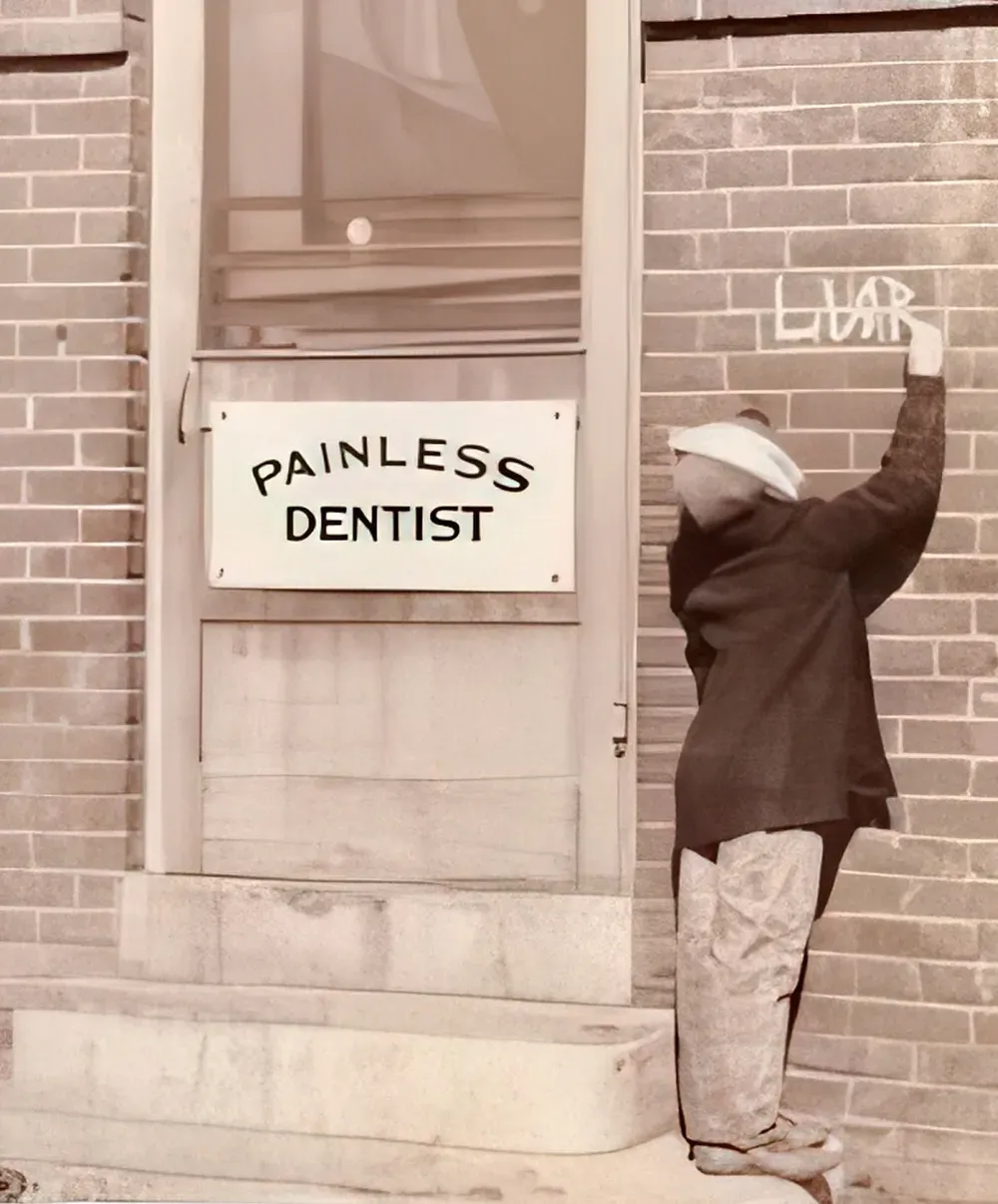
They’re the residue of decades of dentistry that treated patient discomfort as an inevitable side effect. I wrote a dedicated piece on managing postoperative pain for anyone who wants to go deeper.
Dentistry has changed, though. Or, more precisely — it can.
If you know where to look, none of this exists anymore.
What happens when the bone is thin
Start with the actual problem. Many implant patients have lost bone. That’s normal — when a tooth is gone, the bone that supported it resorbs. It’s physiology, nobody’s fault.
The traditional fix is bone regeneration: harvest bone from elsewhere in the body, or use bone substitutes. Place membranes or titanium mesh.
Suture everything shut over a volume larger than what was there originally, which means extensive incisions to mobilize the tissue. It works. But the biological cost is steep.
Wider flaps mean more trauma. More trauma means more pain. More swelling. Longer recovery. Higher complication risk.
It’s surgical arithmetic. More cutting, more suffering.
The alternative exists. It’s called bone expansion.
When the bone is thin but present, you don’t need to add anything. You need to use what’s there, intelligently.
Controlled bone expansion widens the existing ridge without grafts, without donor sites, without membranes. The patient’s own bone is shaped with precision instruments. The implant sits in a natural bony bed, surrounded by vital tissue that heals quickly. Evidence from over 1,400 implants confirms a 98.1% success rate.
A separate meta-analysis, published in 2024 in the Journal of Maxillofacial and Oral Surgery, compared ridge expansion done in a single surgical stage against the classic two-stage approach — the one that requires a second procedure months later. Eleven studies were reviewed, three entered the statistical pooling, and the standardized mean difference favored single-stage by 0.89. Fewer visits means less anticipatory anxiety, the kind that builds up in the waiting, not the kind that hits during surgery. In fairness, though: a separate 2024 comparison of 18 clinical trials found that guided bone regeneration gains a few extra millimeters of horizontal bone compared with expansion — 4 mm against 3.7. When a defect is genuinely large, GBR still has a place. But for a thin, present ridge — the far more common case — that marginal gain doesn’t justify the steeper biological cost.
No mallet. Traditional osteotomes, the kind you strike with a hammer, belong to a kind of surgery I abandoned years ago. Modern instruments work by progressive compression — quiet, without mechanical trauma.
No donor site. The bone isn’t taken from anywhere else in the body. What’s already there gets used, in the right amount, in the right place. These are the concrete advantages of conservative technique over traditional GBR.
Shorter procedures. Skip the grafting and regeneration phase, and surgical time drops sharply. Less time in the chair. Less anxiety.
A light recovery. I’ve seen the difference thousands of times. Patients treated with bone expansion come back to their follow-up surprised. Some never finish the painkillers they were prescribed. Swelling is minimal. Pain is manageable with plain ibuprofen. Return to normal life happens in 1-2 days, not weeks. I wrote about this in more detail in “A Dental Implant Is a Donut”.
The difference isn’t theoretical. It’s daily, lived experience.
When I talk about these techniques, I’m not citing abstract studies. I’m talking about faces I know. Phone calls the day after surgery. Patients coming back and telling me it was nowhere near as bad as they’d feared.
One patient told me something I haven’t forgotten: “Doctor, I spent years putting this off out of fear. If I’d known it was like this, I would’ve come in sooner.”
That’s the point. Fear feeds on not knowing — not in the insulting sense, but literally: not knowing the alternatives exist.
Dental chains and aggressive marketing don’t talk about conservative technique. They talk about implants in a day, miracle solutions, slashed prices. They don’t talk about how the bone itself gets treated. They don’t talk about what happens once you walk out the door.
And, worst of all, they talk about full-mouth extraction: “Better to take it all out, you’ve got periodontitis anyway” — something an overseas call center once told me on the phone, not realizing they were talking to a dentist trying to see how far they’d push an unnecessary treatment plan. I covered this in more depth comparing custom regeneration against All-on-X protocols.
The right question to ask if you’re afraid of the dentist

If you’re weighing an implant and you’re afraid, the question to ask your dentist — beyond the usual “how much” and “how long” — is “how will you increase my bone?”
If the answer involves grafts, extensive donor sites, membranes, and a long healing window, there may be an alternative. Not always. But close to it.
Conservative bone expansion can replace traditional regeneration with equivalent outcomes and a far more bearable path through surgery — a finding the broader literature on split-crest technique backs up.
While we’re on the topic: if you’re wondering how long a dental implant actually lasts, I wrote a piece built specifically around 20-year outcome studies.
Dental fear is legitimate. Giving up on treatment isn’t.
Odontophobia hits people who are intelligent, rational, and courageous everywhere else in their lives.
It isn’t a matter of character. It’s the nervous system responding to a perceived threat — triggered by the situation in front of you, but rooted, ab origine, in a trauma that lives in the unconscious.
The threat can be scaled down, though. Conservative techniques exist. They work. They make implant treatment accessible even to people who once thought they couldn’t face it.
If you’ve put this off for years, if you’ve avoided finding out, if you’ve chosen not to know — consider this: modern oral surgery can be very different from what you’re picturing. And the gap between a heavy recovery and a light one comes down, largely, to the surgeon’s technical choices.
Choose someone who knows how to work with what you have. Not someone who has to add what you’re missing.
References
- Mažutė B, Astramskaitė-Januševičienė I, Juodžbalys G, Razukevičius D. Methods used in adult dental extraction patients to improve psychoemotional status: systematic review. BMC Oral Health. 2026 Jun 8. doi:10.1186/s12903-026-08209-6 · PMID 42252433
- Khanum Z, Shobha ES, Nainoor N, Shaju N. Comparing one-stage versus two-stage ridge splitting procedures: a systematic review and meta-analysis. J Maxillofac Oral Surg. 2024;24(6):1549-1557. doi:10.1007/s12663-024-02240-2 · PMID 41306229
- Vorovenci A, Drafta S, Petre A. Horizontal ridge augmentation through ridge expansion via osseodensification, guided bone regeneration and ridge-split: systematic review and meta-analysis of clinical trials. Biomed Rep. 2024;21(4):139. doi:10.3892/br.2024.1827 · PMID 39161939
- Stonkutė I, Afanasjevas D, Janovskienė A, Razukevičius D, Petronis Ž. Preoperative anxiolysis in surgical care without sedation or general anesthesia: a systematic review. Dent J (Basel). 2026;14(6):327. doi:10.3390/dj14060327 · PMID 42345918
- Liu X, Wang H, Zhao Q, Wang R, Cao H. The effectiveness of virtual reality in relieving anxiety and pain for adult oral surgical procedures patients: a systematic review and meta-analysis. Oral Surg Oral Med Oral Pathol Oral Radiol. 2025;141(4):450-464. doi:10.1016/j.oooo.2025.10.002 · PMID 41407647
FAQ
Why are so many people afraid of the dentist, and what does that fear look like?
What are the specific fears people have about dental treatment, and why are they so common?
Are there less invasive alternatives to traditional oral surgery?
How can I reduce fear and anxiety around dental visits?
If I'm afraid of a procedure and want to know my options, what's the one question to ask?
Are there medications for dental anxiety beyond non-invasive technique?
Cite this article
Ready for theses, slides and papers. If you cite it on a web page, make the URL a link so readers can reach the source.
Bruschi E. Afraid of the Dentist? Let Go of It, for Good. [Internet]. Frosinone (Italy): Bonebenders; 2025 [updated 2026 Jul 16; cited 2026 Oct 25]. Available from: https://bonebenders.com/en/blog/afraid-of-the-dentist-conservative-bone-expansion/ Bruschi, E. (2025, December 14). Afraid of the Dentist? Let Go of It, for Good. Bonebenders. https://bonebenders.com/en/blog/afraid-of-the-dentist-conservative-bone-expansion/
@misc{bruschi2025afraid,
  author       = {Bruschi, Ernesto},
  title        = {Afraid of the Dentist? Let Go of It, for Good.},
  year         = {2025},
  month        = dec,
  howpublished = {Bonebenders},
  url          = {https://bonebenders.com/en/blog/afraid-of-the-dentist-conservative-bone-expansion/},
  note         = {Accessed 2026-10-25}
} Go deeper
Espansione crestale (split crest) →Allargare la cresta senza trapianto — tecnica ERE e bonebending
Need a professional opinion?
Book an appointment at Dr. Bruschi's practice in Frosinone. First visit includes full diagnosis and personalised treatment plan.
Stai valutando un impianto dentale?
Ti hanno detto che non hai abbastanza osso, o ti hanno proposto un’arcata fissa? Ho scritto una guida di dieci pagine: le strade possibili, gli esami che servono e le dieci domande da fare prima di firmare.
Ricevi la guidaStay Updated
New articles on periodontology, implantology and oral surgery — delivered to your inbox.
Comments
Loading comments...
Leave a comment