Fluoride tablets for children: what they actually do
Leggi in Italiano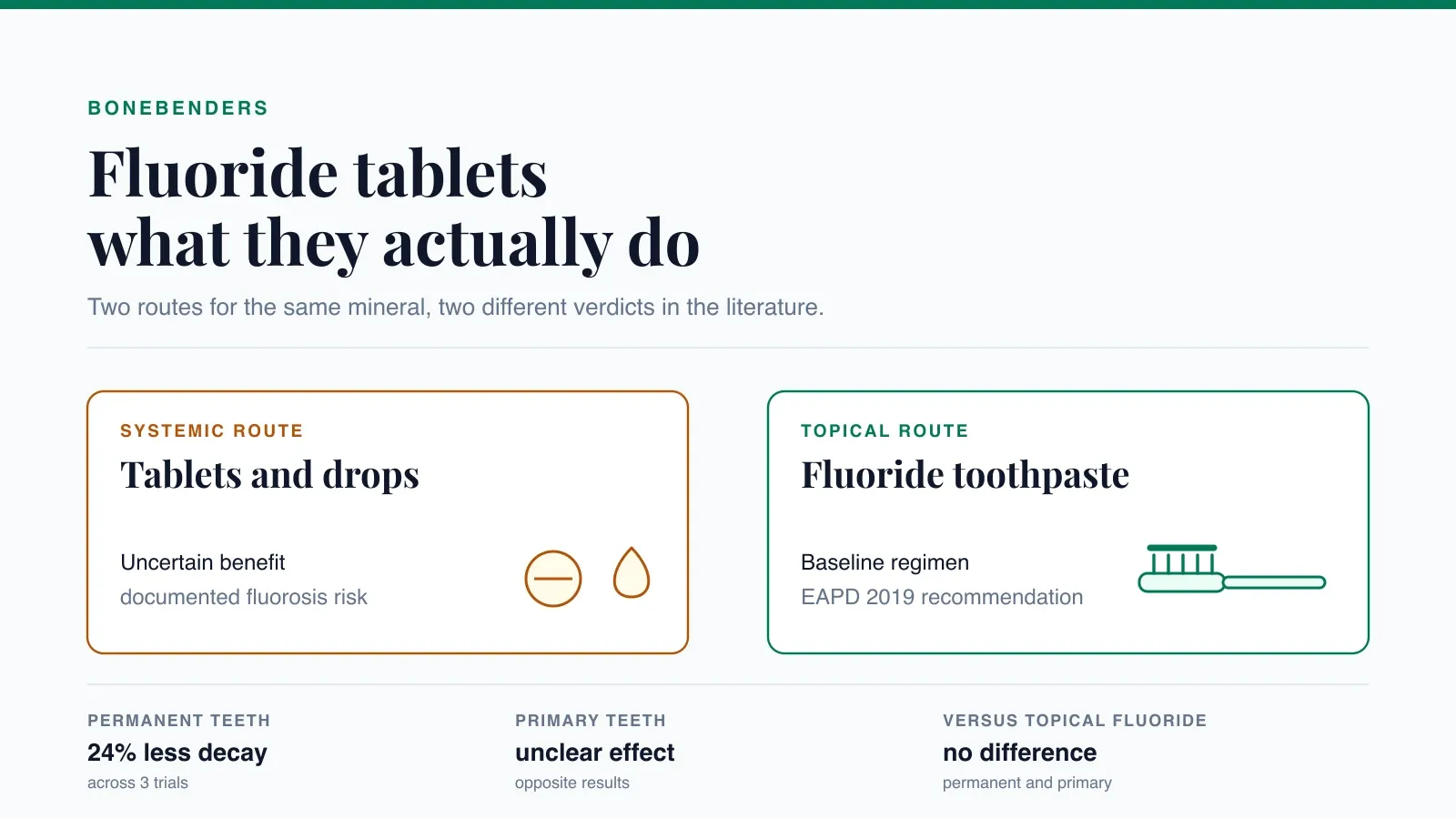
In brief — Fluoride tablets and drops were devised to add the mineral where the water carries none. The Cochrane reviews do find a 24% benefit on permanent teeth, which stays uncertain on primary teeth, and no advantage over fluoride applied to the surface. The price is possible fluorosis. European guidelines put toothpaste first, ahead of routine systemic supplementation.
Do fluoride drops and tablets actually work?
They come from a 1960s idea. Where tap water carried no fluoride, the thought was to give it by mouth. The child swallows it, the fluoride circulates, and the teeth still forming take it into their enamel before they ever erupt.
That enamel builds as fluorapatite instead of ordinary hydroxyapatite. Fluorapatite is thermodynamically more stable and dissolves only at a lower pH, which is what makes acid attack harder.
A reasonable hypothesis, for what was known then. From 1990 onward several countries began to reconsider it.
What the trials found
The Cochrane review by Tubert-Jeannin and colleagues pulled together eleven randomised trials on 7,196 children, all with at least two years of follow-up.
On permanent teeth, comparing tablets against no supplement, the benefit is there: a 24% reduction in decayed, missing and filled surfaces (confidence interval 16–33%). Except that figure rests on three trials.
On primary teeth the result stays unclear. One trial saw no effect at all, another a substantial reduction. With two opposite results, the review stops and says so.
Then comes the comparison that carries the most weight. Set tablets against fluoride applied to the surface — toothpaste, gels, varnishes — and the difference vanishes. No advantage, on permanent or primary teeth.
There is one last figure the authors put plainly, and I would never keep it from a parent. Ten trials out of eleven carry an unclear risk of bias, and one is at high risk. The stated conclusion speaks of weak evidence. That 24% is the best we have, and it is not much.
In pregnancy, no advantage
A second Cochrane review, by Takahashi and colleagues, went looking for trials on tablets given to pregnant women to protect the teeth of the child to come.
It found one. A single randomised trial. No difference at three years (RR 1.46; interval 0.75–2.85 across 938 children), none at five either (RR 0.84; 0.53–1.33 across 798). Certainty of evidence rated very low.
On the strength of that little, taking fluoride during pregnancy for the baby’s teeth has no sound reason behind it.
The fluorosis risk
Fluoride swallowed while enamel is forming can alter it. The condition is dental fluorosis, and it runs from faint white flecks only the dentist notices to defects a teenager carries around and dislikes in the mirror.
Jullien’s review of children under five is blunt on both sides of the ledger: the evidence on oral supplements is “limited and inconsistent”, while supplement intake in early childhood comes out associated with fluorosis risk, in mild forms and in aesthetically significant ones alike.
Casaglia and colleagues, measuring fluoride in the volcanic Castelli Romani area near Rome, add a piece that bears directly on tablets: the rise in fluorosis seen in areas where water fluoride is low gets attributed to excessive and inappropriate intake of drops and lozenges, and to swallowed toothpaste.
Uncertain benefit on one side, documented harm on the other. With a ledger like that, the right question stops being “how much fluoride do I give” and becomes “why am I giving it at all”.
The question about IQ
In March 2025 JAMA Pediatrics published a systematic review and meta-analysis signed by researchers at the US National Institute of Environmental Health Sciences. Seventy-four studies, more than twenty thousand children in the main analysis, and an inverse association between fluoride exposure and IQ scores.
It needs reading in full, because the details change the meaning.
The exposure measured is total, mostly from drinking water, and most of the studies come from China and India, regions where groundwater fluoride runs naturally high, at concentrations well above anything in our mains supply. Fifty-two studies out of seventy-four are rated high risk of bias. In the water analysis the association holds at concentrations below 4 mg/L and below 2 mg/L, and disappears below 1.5 mg/L — the WHO reference value. Restrict the pooling to low risk-of-bias studies, though, and the signal below 1.5 mg/L comes back. The authors themselves write that at those concentrations the data are limited and the uncertainty stands.
So: that study does not say a 0.25 mg tablet lowers your child’s IQ. Nobody has measured it. It says systemic fluoride exposure, taken as a whole, has come under serious scrutiny — and that adding more without a reason is now a choice that needs one.
Should you worry about the IQ of a child who took fluoride? For what my opinion is worth, no. At the doses we are discussing I do not see that risk. There may be any number of unexplored confounders muddying the data in these studies.
What the guideline writers recommend
The European Academy of Paediatric Dentistry updated its guidance in 2019, with a working group devoted specifically to fluoridated milk, fluoridated salt, tablets, lozenges and drops, and a GRADE assessment of the quality of the evidence.
For most European countries the recommendation is single: fluoride toothpaste in the right amount for the age, together with good hygiene, as the baseline regimen. Parents are to be instructed on how much toothpaste to use, and to assist or supervise brushing until at least seven years of age. Fluoride is considered safe when the manufacturer’s instructions are followed, and its use has to be balanced against estimated caries risk and possible adverse effects.
Fluoride has not fallen from grace. It changed its route of administration. Topical works better.
What I would do
If your child is at low caries risk and brushes with an age-appropriate fluoride toothpaste, tablets add little and carry a risk that is possible, unproven, and avoidable. That covers the vast majority of children I see.
If the risk is high — cavities already there, defective enamel, conditions or drugs that cut salivary flow, family situations where daily hygiene is not the first priority — then the conversation changes. In that case the prescriber needs to know how much fluoride is in the water you drink. It is not a detail: in that same volcanic area of Lazio the tap measures between 0.35 and 1.11 ppm, and some bottled waters reach 1.50. Far from the Asian endemic zones, and still enough to put that dose into the total.
One thing I ask explicitly: do not stop a prescribed treatment on your own because you read an article, this one included. Take it to your child’s paediatrician or dentist and ask them to explain the reason behind the prescription. If there is one, they will be able to tell you.
And the rest still holds: brushing twice a day, sugar kept in check, regular check-ups. It is the boring part. It is also what carries people into their eighties with almost all their own teeth.
The principle I wrote about gummy smiles in teenagers applies here too: on a healthy child you do not add a treatment to reassure the adult.
References
- Tubert-Jeannin S, Auclair C, Amsallem E, Tramini P, Gerbaud L, Ruffieux C, et al. Fluoride supplements (tablets, drops, lozenges or chewing gums) for preventing dental caries in children. Cochrane Database Syst Rev. 2011;2011(12):CD007592. doi:10.1002/14651858.CD007592.pub2. PMID: 22161414.
- Takahashi R, Ota E, Hoshi K, Naito T, Toyoshima Y, Yuasa H, et al. Fluoride supplementation (with tablets, drops, lozenges or chewing gum) in pregnant women for preventing dental caries in the primary teeth of their children. Cochrane Database Syst Rev. 2017;10(10):CD011850. doi:10.1002/14651858.CD011850.pub2. PMID: 29059464.
- Toumba KJ, Twetman S, Splieth C, Parnell C, van Loveren C, Lygidakis NA. Guidelines on the use of fluoride for caries prevention in children: an updated EAPD policy document. Eur Arch Paediatr Dent. 2019;20(6):507-16. doi:10.1007/s40368-019-00464-2. PMID: 31631242.
- Jullien S. Prophylaxis of caries with fluoride for children under five years. BMC Pediatr. 2021;21(Suppl 1):351. doi:10.1186/s12887-021-02702-3. PMID: 34496756.
- Taylor KW, Eftim SE, Sibrizzi CA, Blain RB, Magnuson K, Hartman PA, et al. Fluoride exposure and children’s IQ scores: a systematic review and meta-analysis. JAMA Pediatr. 2025;179(3):282-92. doi:10.1001/jamapediatrics.2024.5542. PMID: 39761023.
- Casaglia A, Cassini MA, Condò R, Iaculli F, Cerroni L. Dietary fluoride intake by children: when to use a fluoride toothpaste? Int J Environ Res Public Health. 2021;18(11):5791. doi:10.3390/ijerph18115791. PMID: 34071256.
FAQ
Does my child need fluoride drops?
Does fluoride during pregnancy protect the baby's teeth?
What is dental fluorosis?
Does fluoride lower a child's IQ?
What do European guidelines recommend?
Go deeper
Espansione crestale (split crest) →Allargare la cresta senza trapianto — tecnica ERE e bonebending
Need a professional opinion?
Book an appointment at Dr. Bruschi's practice in Frosinone. First visit includes full diagnosis and personalised treatment plan.
Stay Updated
New articles on periodontology, implantology and oral surgery — delivered to your inbox.
Comments
Loading comments...
Leave a comment