Your Front Teeth Are Moving Because You Lost a Molar
Leggi in Italiano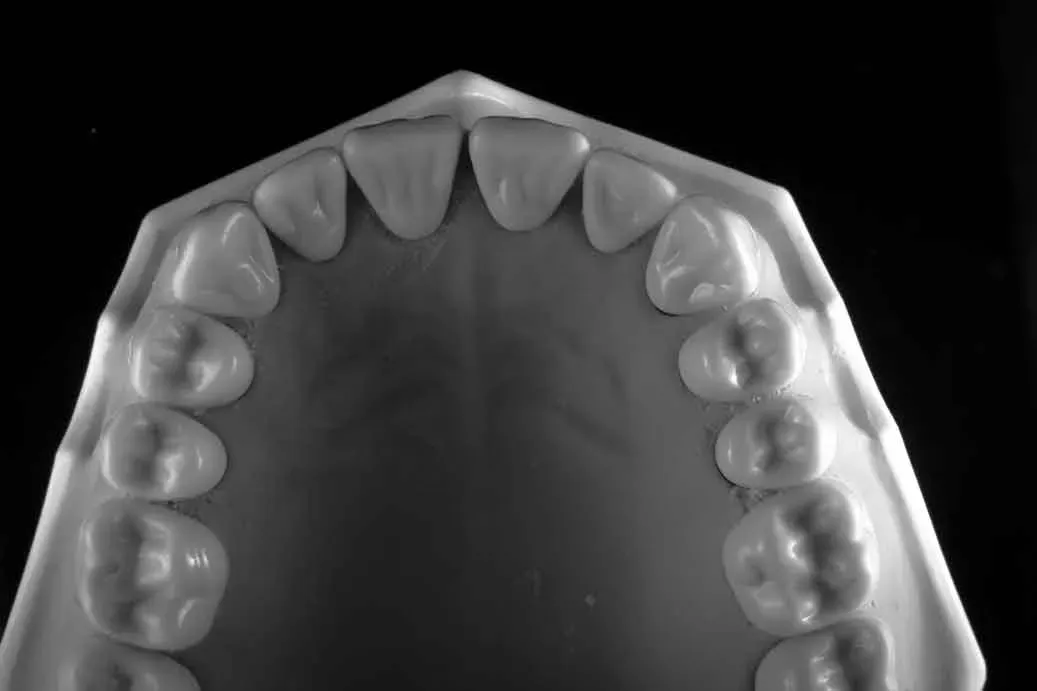
In brief — Losing a molar causes pathologic migration of the upper incisors, because chewing forces redistribute toward the front of the mouth. 74% of patients with advanced periodontitis show incisor shifting. Replacing the molar promptly prevents all of this.
There’s a truth patients are rarely told: front teeth aren’t designed to chew.
Incisors exist to cut, guide jaw movement, and refine each bite before it’s swallowed.
It’s a delicate, precise, almost surgical job. The real force of chewing — the one that grinds food into smaller particles — belongs instead to the molars, the silent giants of the mouth.
And, for the record, incisors aren’t meant for biting your nails either.
Dental school teaches that incisors should barely touch, not bite together. That’s how it should work in prosthetic reconstructions and complex rehabilitations too: light contact up front, full function in the back. It’s a fundamental biomechanical principle.
Different teeth groups have different jobs, by design
Nature assigned each tooth a precise role.
Incisors are small chisels, canines are sturdy hooks that tear food with force, premolars are robust scissors. Molars, on the other hand, are like the millstones of a mill — the powerhouse of the chewing system.
When one of them is lost, it’s not just a tooth that disappears: an essential gear jams.
At first, nothing seems to happen. You chew on the other side, you get used to it, you tell yourself “it’s in the back, no one sees it, it doesn’t bother me.” But while the patient adapts, the mouth begins an invisible, gradual process.
Chewing forces shift forward, the jaw changes its trajectory, and the remaining teeth try to take on a function that isn’t theirs.
The incisors — elegant, thin cathedrals of enamel, built to handle minimal, horizontal forces — start absorbing intense, repeated vertical loads instead. Then they give way. Slowly, but inevitably.
The incisors give way
If they don’t fracture, they drift.
First they shift slightly. Then gaps open up between them. Mobility and sensitivity appear. This phenomenon, known in the scientific literature as pathologic tooth migration, affects between 30% and 56% of patients with moderate to severe periodontitis.
That’s the moment a patient notices a diastema (a gap between teeth) that was never there before, or feels that an incisor “isn’t as solid as it used to be.”
But what they see is only the last chapter of a story that began much earlier: the collapse of the posterior foundations.
If gum problems or bone loss are added to the mix, the movement becomes even more obvious and faster, because the abnormal force is compounded by the loss of periodontal support. A study published in Frontiers in Oral Health found that in patients with stage III-IV periodontitis, pathologic migration of the upper incisors occurs in 74.4% of cases.
A 2025 literature review in BMC Oral Health, by Pang and colleagues, confirms the picture and adds a detail worth underlining: in the early stages, spontaneous repositioning of the incisors can happen after periodontal therapy alone, without any orthodontics needed. In their case — stage III grade C aggressive periodontitis — the interdental gaps closed with scaling, root planing, and guided tissue regeneration, followed by 4 years of documented stability. (DOI)
But that window closes. The longer you wait, the less biology cooperates on its own.
Almost always, behind incisor mobility there’s a molar lost years earlier and never replaced.
Over time, the adjacent teeth tilt, the contacts shift, the opposing molar over-erupts for lack of contact, and the whole chewing system deforms. It’s a slow process, imperceptible day to day, but relentless in its progression.
The more time passes, the harder the defect is to correct
Once the problem becomes obvious, restoring it gets far more complex. It’s no longer a matter of “putting the molar back”: it means correcting tilted teeth, recovering space, rebuilding the bone lost at the extraction site, and re-establishing a coherent bite.
It’s entirely possible, but it requires longer, more demanding, and more expensive treatment. And all of it could have been avoided by acting right away, when that molar was first lost.
The long-term data confirm this, in both directions. Georgantza and colleagues documented 84 months of periodontal stability in a case of severe migration treated with a combined approach — non-surgical therapy, orthodontics, prosthetics — avoiding the extraction that would have been the “safe” choice. (DOI) On the other side, Kudo and Shirakata followed a patient with stage IV grade C periodontitis for 10 years, treated with implants placed strategically before orthodontics (the SIMBO protocol): the result held, but only after a multidisciplinary plan built from scratch. (DOI) The difference between the two cases isn’t the clinician’s skill. It’s how much time had passed before treatment started.
The real prevention, in dentistry, isn’t just brushing well and getting regular checkups. It means preserving the integrity of the posterior arch, keeping active the pillars that let the mouth function in harmony.
Molars aren’t “second-tier” teeth just because they don’t show when we smile. They’re the load-bearing beams of a building we want to keep solid for a lifetime.
The mouth is an integrated system, a delicate balance where everything is connected. Losing a molar means breaking that balance and forcing other structures to compensate. The incisors are the last to give way, but that’s exactly why they’re the clearest warning sign: when they start moving, it means the system is at its limit.
What you can do to prevent all of this
The message is simple: if you’ve lost a molar, don’t wait. Don’t assume it’s unimportant just because it doesn’t show. Molars are the guardians of function. Taking care of them means protecting the whole mouth — especially those front teeth you see in the mirror every day.
Even when migration is already advanced, recent data are less fatalistic than commonly believed. A 2025 study from Peking University School of Stomatology, covering 26 patients with severe periodontitis and 217 migrated anterior teeth, found that clear-aligner orthodontics combined with regular periodontal maintenance significantly improves occlusal and proximal contact while keeping probing depth stable over time. (DOI) That’s not a reason to wait. It’s proof that even in the worst-case scenario, there’s a way back — just a longer one than if you’d acted right away.
Restoring molars to their natural role, through solutions like immediate-loading implants, a bridge when the situation calls for it, or custom regeneration, isn’t just treatment: it’s an investment in your health, your appearance, and the longevity of your smile.
And your incisors, I promise you, will thank you for it.
References
- Brunsvold MA. Pathologic tooth migration. J Periodontol. 2005;76(6):859-866. doi:10.1902/jop.2005.76.6.859. PMID: 15948679.
- Pang Y, Li J, Zheng S, Wang J. Spontaneous repositioning of pathologically migratory mandibular anterior teeth following periodontal surgical treatment: a case report with 4-year follow-up and literature review. BMC Oral Health. 2025;25(1):749. doi:10.1186/s12903-025-06111-1. PMID: 40399887.
- Georgantza A, Manasse M, Tupinambá R, Nobrega C, Pigliacelli S, Cheng Paul Yu Y, et al. Saving teeth: Revisited. Esthetic improvement and long-term periodontal stability of a pathologic tooth migration case: An 84-month follow-up. Clin Adv Periodontics. 2023;13(4):258-265. doi:10.1002/cap.10244. PMID: 37126210.
- Kudo M, Shirakata Y. Multidisciplinary approach involving strategic implant placement before orthodontic (SIMBO) treatment for generalized stage IV grade C periodontitis: A case report with 10-year follow-up. J Esthet Restor Dent. 2023;35(8):1171-1185. doi:10.1111/jerd.13075. PMID: 37350421.
- Li J, Zhu Z, Jiao J, Shi J. Clinical efficacy of clear aligner treatment for pathologically migrated teeth in the anterior region of patients with severe periodontitis. Beijing Da Xue Xue Bao Yi Xue Ban. 2025;57(1):51-56. doi:10.19723/j.issn.1671-167X.2025.01.008. PMID: 39856506.
FAQ
How long does it take for incisors to start moving after a molar is lost?
Can I wait to replace an extracted molar if it doesn't bother me?
If my incisors have already shifted, is it too late to fix it?
How do I know if my incisors are shifting?
Does periodontitis speed up incisor migration?
Can a bridge replace a missing molar and prevent all this?
Can losing just one molar really cause all these problems?
I lost a molar many years ago but my incisors seem stable. Should I still be worried?
Cite this article
Ready for theses, slides and papers. If you cite it on a web page, make the URL a link so readers can reach the source.
Bruschi E. Your Front Teeth Are Moving Because You Lost a Molar [Internet]. Frosinone (Italy): Bonebenders; 2025 [updated 2026 Jul 11; cited 2026 Oct 25]. Available from: https://bonebenders.com/en/blog/incisor-migration-after-molar-loss/ Bruschi, E. (2025, December 2). Your Front Teeth Are Moving Because You Lost a Molar. Bonebenders. https://bonebenders.com/en/blog/incisor-migration-after-molar-loss/
@misc{bruschi2025incisor,
  author       = {Bruschi, Ernesto},
  title        = {Your Front Teeth Are Moving Because You Lost a Molar},
  year         = {2025},
  month        = dec,
  howpublished = {Bonebenders},
  url          = {https://bonebenders.com/en/blog/incisor-migration-after-molar-loss/},
  note         = {Accessed 2026-10-25}
} Go deeper
Espansione crestale (split crest) →Allargare la cresta senza trapianto — tecnica ERE e bonebending
Need a professional opinion?
Book an appointment at Dr. Bruschi's practice in Frosinone. First visit includes full diagnosis and personalised treatment plan.
Stai valutando un impianto dentale?
Ti hanno detto che non hai abbastanza osso, o ti hanno proposto un’arcata fissa? Ho scritto una guida di dieci pagine: le strade possibili, gli esami che servono e le dieci domande da fare prima di firmare.
Ricevi la guidaStay Updated
New articles on periodontology, implantology and oral surgery — delivered to your inbox.
Comments
Loading comments...
Leave a comment