Mesalazine breaks the membrane of Porphyromonas gingivalis
Leggi in Italiano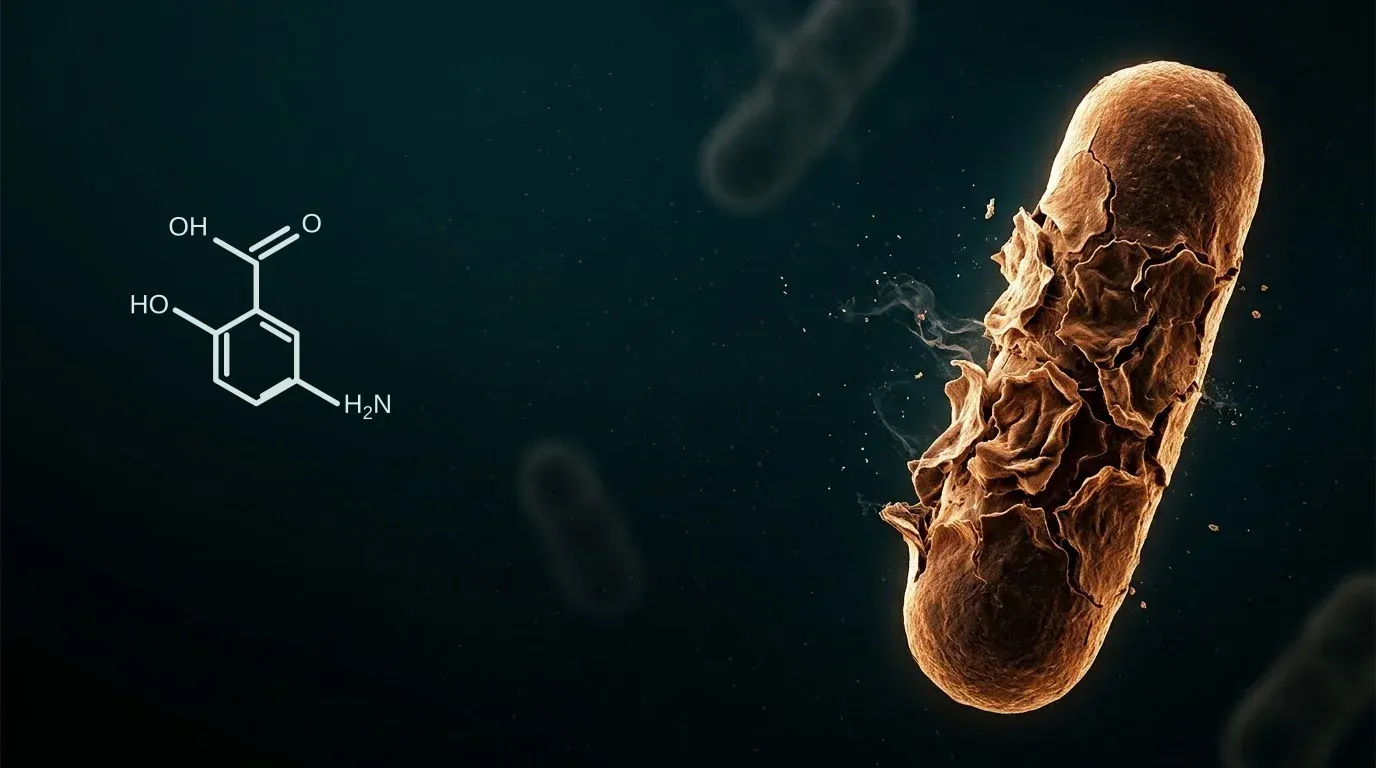
In brief — A research group at Jilin University, in a remote province of north-eastern China bordering Russia and North Korea, reports that mesalazine — the first-line anti-inflammatory in chronic inflammatory bowel disease — damages the membrane of Porphyromonas gingivalis, disrupts established biofilm and reduces alveolar bone resorption in rats. The concentrations required are high and the route is local injection, so even if the effect held in humans, that way of using the drug would not be workable today. The more interesting finding sits elsewhere: in the mouth–gut axis.
The drug
Mesalazine is 5-aminosalicylic acid, a close relative of the far better known aspirin. In gastroenterology it is the first-line anti-inflammatory in ulcerative colitis, where it acts on the colonic mucosa. Nobody thinks of it as an antibacterial.
The Jilin group tried using it as one. In their paper in Frontiers in Microbiology, concentrations between 0.5 and 2 mg/mL inhibited the proliferation of P. gingivalis over seventy-two hours, with a minimum inhibitory concentration of 2 mg/mL (Wang et al., 2025). Under atomic force microscopy the bacterial surface treated with 1 mg/mL appears wrinkled and broken. The wall and the membrane give way, confirmed by alkaline phosphatase and lactate dehydrogenase activity measured in the supernatant — intracellular content spilling into the culture.
What concerns anyone treating periodontitis is the effect on the biofilm as a whole. The drug does not merely prevent its formation: it also breaks up biofilm that is already structured, both pure P. gingivalis and multispecies, built with Fusobacterium nucleatum and Streptococcus sanguinis. PCR analysis shows reduced expression of the gingipain genes and of the adhesion genes.
In the in vivo model — Sprague-Dawley rats, ligature-induced experimental periodontitis, six animals per group — mesalazine was injected into the submucosal tissues at the mid-buccal and mid-palatal points of the maxillary first molars, twenty microlitres at 1 mg/mL, three times a week for two weeks. On micro-CT the bone volume fraction rises from roughly 35% to 78%, the distance between the cemento-enamel junction and the alveolar crest shortens, and 16S sequencing shows a fall in Porphyromonas, Fusobacterium and other species.
Dose and delivery
Two milligrams per millilitre is a lot. A conventional antibiotic works in micrograms per millilitre, and three orders of magnitude are not a laboratory detail. They tell us mesalazine is not potent against this organism, and that the result depends entirely on the concentration you can hold at the site.
Two consequences follow. The first is that the systemic route is out of the question, and with it the appealing idea that a patient already treated for colitis is protecting the periodontium as well. They are not. Oral mesalazine formulations are built to release the compound in the colon, not to saturate a gingival sulcus.
The second is that the local route, workable in principle, carries the practical problems common to every topical antimicrobial. Saliva and crevicular fluid dilute whatever we place in the pocket, as anyone knows who has used an antiseptic hoping it would stay where it was put. The authors write it plainly: a more stable delivery system is needed.
This is not a generic promise. A few months later the same group published, in Colloids and Surfaces B, a thermosensitive hydrogel of chitosan, β-glycerophosphate and gelatin loaded with mesalazine, injectable into the pocket (Wang H et al., 2025). In their work the released drug reduces IL-6, TNF-α and PGE2 synthesis in macrophages by inhibiting PI3K and AKT phosphorylation; in rats it reduces inflammatory infiltrate, supports the formation of a new junctional epithelium and slows bone resorption. It is the logical sequel to the first paper, and it is what makes this line of research clinically interesting.
The mouth–gut axis runs one way
Here comes the less intuitive part.
The premise of both Jilin studies is that periodontitis and inflammatory bowel disease share dysbiosis, inflammatory mechanisms and therefore possible therapies. The association certainly exists: a meta-analysis of eleven studies found a higher likelihood of periodontitis in patients with inflammatory bowel disease, with an odds ratio of 2.28 (Naghsh et al., 2025). That figure, however, comes from cross-sectional studies, which photograph two concurrent conditions and say nothing about which arrived first.
According to Wang and colleagues in the Journal of Periodontal Research, periodontitis does not raise the risk of inflammatory bowel disease, with a pooled relative risk of 1.04 (Wang Q et al., 2024). The risk rises only for ulcerative colitis, not for Crohn’s disease. In the opposite direction the effect is there and it is not small: people with inflammatory bowel disease develop periodontitis more often.
The animal model tells a different story. A review of thirty-four studies in mice and rats showed that inoculation with periodontal bacteria worsens experimental colitis, the strongest effect coming from F. nucleatum and probably also P. gingivalis; the same authors write that whether colitis affects periodontal status remains unclear (Akash et al., 2025).
It is worth keeping both feet on the ground: knowing the mechanisms by which periodontal pathogens may influence general health, and at the same time avoiding claims that go beyond what has been shown. Many links between oral dysbiosis and systemic disease do exist, as we have seen with Porphyromonas invasion of host cells and with periodontitis and Alzheimer’s. But it is wise to stay cautious rather than alarmist.
That caution takes nothing away from what we know about the periodontal pocket itself, where the comparison between peri-implant and periodontal microbiota keeps showing how plural these communities are.
What changes in treatment
Today, nothing. We remain a long way from a mesalazine-based product for the topical treatment of periodontal disease.
History taking is another matter. A patient with ulcerative colitis or Crohn’s disease carries a risk of developing periodontitis about a third higher than someone without it. That risk is real. It means shorter recall intervals and a full periodontal chart even when the initial picture looks unremarkable.
It is also worth remembering that the intermittent steroid therapy these patients receive affects tissue healing when they are treated surgically.
Cover image: illustration generated with artificial intelligence, with the structural formula of mesalazine superimposed. It is not a micrograph and does not represent a real specimen.
References
- Wang Y, Ma J, Wang H, Yi J, Bai Y, Hu M, Yan J. Mesalazine: a novel therapeutic agent for periodontitis via regulation of periodontal microbiota and inhibiting Porphyromonas gingivalis. Front Microbiol. 2025;16:1531258. doi:10.3389/fmicb.2025.1531258 · PMID: 39911249
- Frontiers Production Office. Correction: Mesalazine: a novel therapeutic agent for periodontitis via regulation of periodontal microbiota and inhibiting Porphyromonas gingivalis. Front Microbiol. 2025;16:1638611. doi:10.3389/fmicb.2025.1638611 · PMID: 40718810
- Wang H, Wang Y, Yi J, Bai Y, Zhang Y, Hu M, Yan J. Hydrogel loaded with mesalazine for local injected treatment of periodontitis with superior anti-inflammatory, mucosal healing and bone repair performance. Colloids Surf B Biointerfaces. 2025;255:114881. doi:10.1016/j.colsurfb.2025.114881 · PMID: 40544687
- Wang Q, Chen S, Zhou J, Zhao L. Bidirectional associations between periodontitis and inflammatory bowel disease: A systematic review of longitudinal studies with meta-analysis and trial sequential analysis. J Periodontal Res. 2024;59(6):1083-1094. doi:10.1111/jre.13291 · PMID: 38837416
- Akash H, Pandis N, Manschiebel W, Burisch J, Bertl K, Stavropoulos A. A Systematic Review and Meta-Analysis of Animal Models on the Possible Link Between Periodontitis and Inflammatory Bowel Diseases. Inflamm Bowel Dis. 2025;31(9):2561-2583. doi:10.1093/ibd/izaf087 · PMID: 40705381
- Naghsh N, Karimi F, Tarrahi MJ, Rahimi A. Evaluation of the association between periodontitis and inflammatory bowel disease: A systematic review and Meta-analysis. BMC Gastroenterol. 2025;25(1):594. doi:10.1186/s12876-025-04181-7 · PMID: 40826333
FAQ
Can mesalazine be used to treat periodontitis today?
Is the periodontium better protected in a patient taking mesalazine for ulcerative colitis?
If the association runs mainly in one direction, is there still a reason to treat periodontitis in these patients?
Is this not another rodent study that will never reach the clinic?
What should I ask a patient with inflammatory bowel disease at history taking?
Cite this article
Ready for theses, slides and papers. If you cite it on a web page, make the URL a link so readers can reach the source.
Bruschi E. Mesalazine breaks the membrane of Porphyromonas gingivalis [Internet]. Frosinone (Italy): Bonebenders; 2026 [updated 2026 Nov 15; cited 2026 Nov 16]. Available from: https://bonebenders.com/en/blog/mesalazine-periodontitis-gut-oral-axis/ Bruschi, E. (2026, November 15). Mesalazine breaks the membrane of Porphyromonas gingivalis. Bonebenders. https://bonebenders.com/en/blog/mesalazine-periodontitis-gut-oral-axis/
@misc{bruschi2026mesalazine,
  author       = {Bruschi, Ernesto},
  title        = {Mesalazine breaks the membrane of Porphyromonas gingivalis},
  year         = {2026},
  month        = nov,
  howpublished = {Bonebenders},
  url          = {https://bonebenders.com/en/blog/mesalazine-periodontitis-gut-oral-axis/},
  note         = {Accessed 2026-11-16}
} Go deeper
Espansione crestale (split crest) →Allargare la cresta senza trapianto — tecnica ERE e bonebending
Need a professional opinion?
Book an appointment at Dr. Bruschi's practice in Frosinone. First visit includes full diagnosis and personalised treatment plan.
Stay Updated
New articles on periodontology, implantology and oral surgery — delivered to your inbox.
Comments
Loading comments...
Leave a comment