A Snare Strangles the Bacterial Ribosome: Lariocidin
Leggi in Italiano
In brief — Lariocidin is a new lasso-peptide antibiotic, discovered in the bacterium Paenibacillus, that hits the ribosome at a site no other antibiotic has ever touched, with very low potential for resistance to develop. It works against both Gram-positive and Gram-negative bacteria and could find a role against mixed-flora infections in dentistry and as peri-operative cover — the same role Cochrane-level evidence already assigns to a single preoperative dose of amoxicillin.
Nature published the discovery of a new antibiotic in March 2025.
Jangra, M., Travin, D.Y., Aleksandrova, E.V. et al. A broad-spectrum lasso peptide antibiotic targeting the bacterial ribosome. Nature 640, 1022–1030 (2025). https://doi.org/10.1038/s41586-025-08723-7
It’s called lariocidin, and it comes from the bacterium Paenibacillus sp. M2. It’s a lasso peptide — a molecule folded into a knotted structure that researchers have studied for years without ever landing a convincing clinical application.
This time is different. Lariocidin binds the bacterial ribosome at a site nobody had seen before. It blocks protein synthesis and scrambles the translation of the genetic code. The bacteria die. It works against both Gram-positive and Gram-negative bacteria — rare for this class of molecule.
Why a new antibiotic at all?
In 2021, antimicrobial resistance (AMR) caused 1.32 million deaths directly worldwide, with another 4.86 million deaths associated with it — a substantial rise since 1990. The reference study is Global burden of bacterial antimicrobial resistance 1990–2021: a systematic analysis with forecasts to 2050, published in The Lancet in 2024.
Most of the attributable deaths trace back to just six key pathogens, including Staphylococcus aureus (methicillin-resistant, or MRSA), Escherichia coli, and Klebsiella pneumoniae (resistant to third-generation cephalosporins).

One key finding is the stark geographic and age disparity. The impact falls disproportionately on sub-Saharan Africa and South Asia, and the highest — and worsening — burden lands on children under five.
Looking ahead, the study projects that, absent “substantial action,” annual deaths attributable to AMR will climb to 2.45 million globally by 2050, overtaking the combined toll of HIV/AIDS and malaria. The authors conclude that this alarming burden demands immediate, substantial investment in surveillance, infection prevention, antibiotic stewardship, and research into new antibiotics — especially in low- and middle-income countries.
Possible future clinical relevance in dentistry
For us as dentists, the relevant fact is the broad-spectrum activity. Oral infections almost always involve mixed flora — streptococci, staphylococci, anaerobes, Gram-negative bacteria. An antibiotic effective against many different pathogens simplifies treatment across several infection types.
It could also serve as peri-operative cover in oral surgery and implantology, again because of its wide spectrum. Post-operative adverse events linked to infection might drop with molecules more effective against resistant pathogens.
The strongest reference here is still the Cochrane review by Esposito and colleagues, updated in 2013 across six randomized trials and 1,162 patients: a single 2 or 3 g dose of amoxicillin, given orally one hour before surgery, reduces implant failure with statistical significance (relative risk 0.33; 95% CI 0.16-0.67; p=0.002), with a number needed to treat of 25. It’s the evidence behind the protocol we already recommend — one dose, not an extended course.
A more recent meta-analysis by Momand and colleagues, on a different pool of seven trials and 3,014 implants, did not confirm statistical significance (relative risk 0.66; 95% CI 0.30-1.47) — a result that depends heavily on the larger, more recent trials it pooled in, and one that for now stands as a minority view against the Cochrane body of evidence. The cost and risk of a single dose stay close to zero, and the expected benefit stays real — reason enough to leave the clinical protocol as it is, even while its exact size is still debated across meta-analyses. Díaz and colleagues, in a 2025 umbrella review on maxillary sinus lift — a more extensive procedure than straightforward implant placement — find that systematic prophylaxis adds the most benefit in high-risk scenarios: membrane perforation, an extensive lateral approach, systemic comorbidities. If lariocidin or similar molecules ever reach dentistry, they’ll face the same bar: a benefit demonstrated in well-conducted clinical trials, not just a wide spectrum in the lab.
The mechanism of action
The mechanism is new. No other antibiotic binds that spot on the ribosome. Common resistance mechanisms don’t apply. Bacteria resistant to methicillin, aminoglycosides, and macrolides stay sensitive to lariocidin. Researchers tried selecting for resistant strains in the lab, and they only rarely managed to survive.
The mutations needed to develop resistance damaged the bacterium too much.
The molecule works in a particular way. It wedges between ribosomal RNA and tRNA (transfer RNA) during translation. It blocks the ribosome’s translocation along the mRNA. The result: proteins get made wrong, or not made at all. The faulty membrane proteins trigger stress responses that kill the cell.
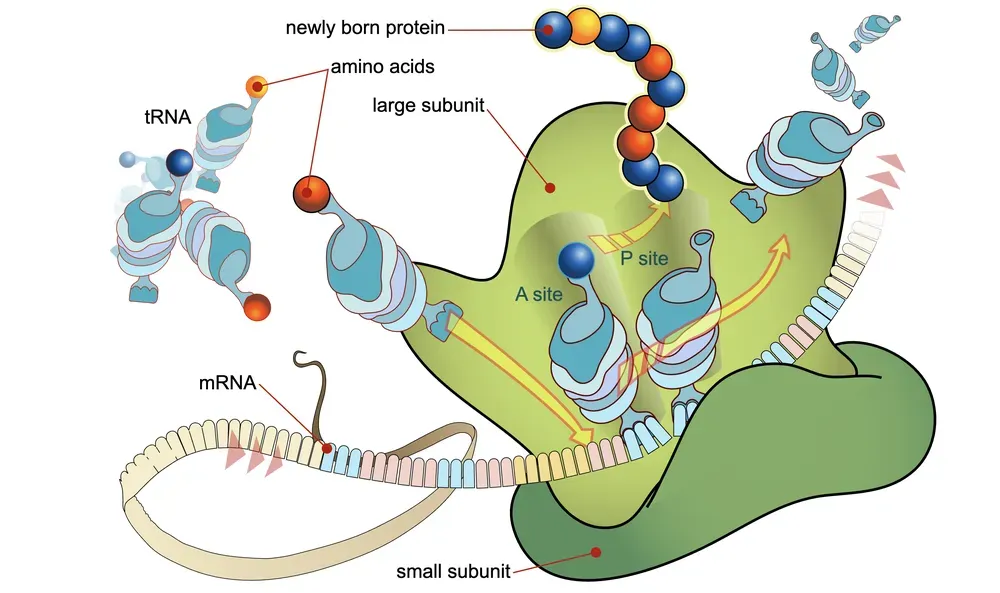
Structural studies show lariocidin exists in two forms. One is the linear peptide cyclized into a lasso. The other carries an additional internal cyclization. Both forms are active. Both bind the ribosome the same way.
The follow-up: how the producing bacterium protects itself
In January 2026, the same research group — McMaster University and the University of Illinois at Chicago — published a second study, this time on the producing bacterium’s self-resistance mechanism. Jangra and colleagues identified an enzyme, an acetyltransferase called LrcE, that Paenibacillus sp. M2 uses to modify its own lariocidin and protect itself from the toxicity: it acetylates a critical lysine residue on the molecule, blocking it from binding the ribosome.
The useful news for clinical development is where this enzyme doesn’t turn up. LrcE homologs appear in environmental bacteria, not in clinically relevant pathogens. The risk of this specific resistance mechanism spreading horizontally to bacteria that actually infect patients is, for now, judged low by the authors themselves — a finding that makes lariocidin a sturdier candidate, not just a laboratory curiosity.
The road ahead
Plenty of open questions remain. Clinical trials will take years. But the scientific foundation is building: two reviews published in 2026 — one in Antibiotics by Wahnou and colleagues, the other in Molecules by Yilmaz and colleagues — now place lariocidin among the short list of new antibiotic classes, alongside already-approved combinations like sulbactam/durlobactam and aztreonam/avibactam, and the first new-class antibiotic for urinary tract infections, gepotidacin. It’s part of a real shift, however slow, in the antibiotic pipeline.
Lasso peptides were considered interesting but not particularly promising. Nobody had found one that hit the ribosome before. Now we know they exist, and that they work well.
The impact on dental practice is a long way off, and it will need to clear a bar that’s already high: the one set by the Cochrane evidence on preoperative amoxicillin. Still, these developments are worth following. Antibiotic resistance is a real problem. It needs new molecules, proven in real clinical trials, not just in the lab. Lariocidin might be one of them.
References
- Jangra M, Travin DY, Aleksandrova EV, et al. A broad-spectrum lasso peptide antibiotic targeting the bacterial ribosome. Nature. 2025;640(8060):1022-1030. doi:10.1038/s41586-025-08723-7. PMID: 40140562.
- Jangra M, Travin DY, Kaur M, Hackenberger D, Koteva K, Polikanov YS, et al. An acetyltransferase conferring self-resistance of the producer to lasso peptide antibiotic lariocidin. ACS Infect Dis. 2026;12(2):714-723. doi:10.1021/acsinfecdis.5c00885. PMID: 41532636.
- Wahnou H, El Kebbaj R, Demoré B, Limami Y, Duval RE. Current state of the fight against antimicrobial resistance: what are the different strategies for tomorrow? Antibiotics (Basel). 2026;15(6):564. doi:10.3390/antibiotics15060564. PMID: 42353688.
- Momand P, Naimi-Akbar A, Hultin M, Lund B, Götrick B. Is routine antibiotic prophylaxis warranted in dental implant surgery to prevent early implant failure? A systematic review. BMC Oral Health. 2024;24(1):842. doi:10.1186/s12903-024-04611-0. PMID: 39054434.
- Díaz L, Ivanković M, Urrutia P, Uriarte X, Olivares M, Torres A, et al. Use of antibiotics for prevention and treatment of sinus lift infections: an umbrella review of systematic reviews and meta-analyses. BMC Oral Health. 2025;26(1):152. doi:10.1186/s12903-025-07465-2. PMID: 41413511.
- Esposito M, Grusovin MG, Worthington HV. Interventions for replacing missing teeth: antibiotics at dental implant placement to prevent complications. Cochrane Database Syst Rev. 2013;2013(7):CD004152. doi:10.1002/14651858.CD004152.pub4. PMID: 23904048.
FAQ
What is the main discovery published in Nature in March 2025 about antibiotics?
Why do we need new antibiotics like lariocidin at all?
How is lariocidin different from other antibiotics?
What is lariocidin's mechanism of action?
What clinical role could lariocidin play in dentistry?
If the producing bacterium already knows how to protect itself from lariocidin, won't it lose effectiveness quickly in patients too?
Does antibiotic prophylaxis before an implant really reduce failure risk?
Cite this article
Ready for theses, slides and papers. If you cite it on a web page, make the URL a link so readers can reach the source.
Bruschi E. A Snare Strangles the Bacterial Ribosome: Lariocidin [Internet]. Frosinone (Italy): Bonebenders; 2025 [updated 2026 Jul 23; cited 2026 Oct 25]. Available from: https://bonebenders.com/en/blog/lariocidin-antibiotic-bacterial-ribosome/ Bruschi, E. (2025, December 17). A Snare Strangles the Bacterial Ribosome: Lariocidin. Bonebenders. https://bonebenders.com/en/blog/lariocidin-antibiotic-bacterial-ribosome/
@misc{bruschi2025lariocidin,
  author       = {Bruschi, Ernesto},
  title        = {A Snare Strangles the Bacterial Ribosome: Lariocidin},
  year         = {2025},
  month        = dec,
  howpublished = {Bonebenders},
  url          = {https://bonebenders.com/en/blog/lariocidin-antibiotic-bacterial-ribosome/},
  note         = {Accessed 2026-10-25}
} Go deeper
Espansione crestale (split crest) →Allargare la cresta senza trapianto — tecnica ERE e bonebending
Need a professional opinion?
Book an appointment at Dr. Bruschi's practice in Frosinone. First visit includes full diagnosis and personalised treatment plan.
Stai valutando un impianto dentale?
Ti hanno detto che non hai abbastanza osso, o ti hanno proposto un’arcata fissa? Ho scritto una guida di dieci pagine: le strade possibili, gli esami che servono e le dieci domande da fare prima di firmare.
Ricevi la guidaStay Updated
New articles on periodontology, implantology and oral surgery — delivered to your inbox.
Comments
Loading comments...
Leave a comment