Bone Metabolism Mediators: Molecules with 1000 Functions
Leggi in Italiano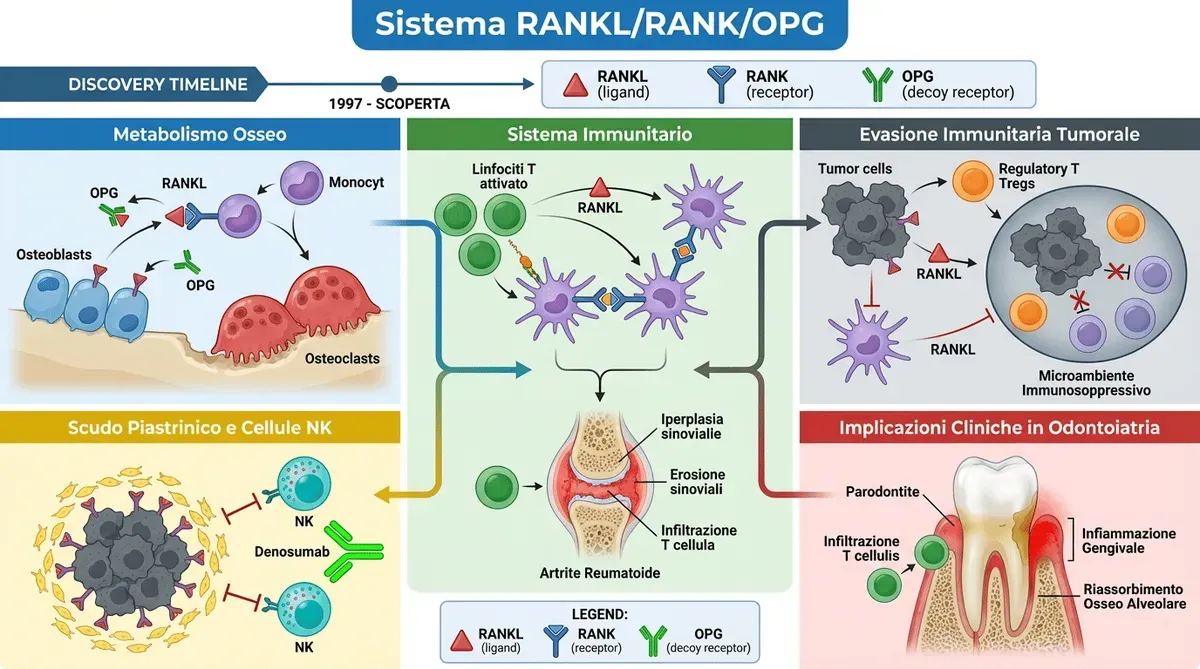
In brief — RANKL, RANK and OPG jointly govern bone remodeling and immunity. The same molecules that decide whether bone resorbs also shape immune responses. In the mouth they matter for periodontitis, implants and patients on denosumab.
In 1997 three groups, working apart, landed on the same protein. We now call it RANKL — Receptor Activator of Nuclear Factor κB Ligand. Yasuda retold that discovery in Journal of Bone and Mineral Metabolism in 2021: a finding that rewrote bone metabolism and, with it, parts of immunology.
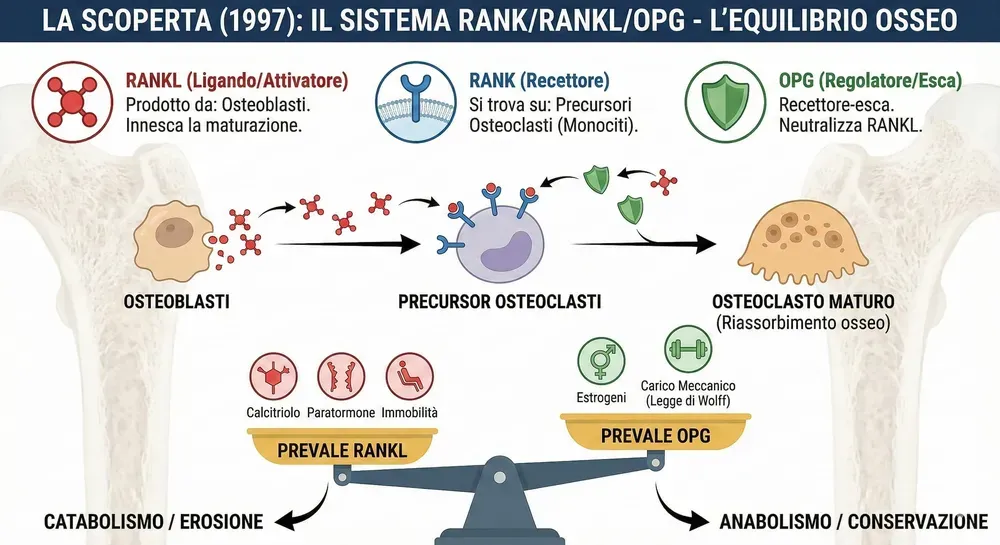
RANKL is a TNF-family cytokine. Osteoblasts make it, display it on the membrane and release it into the extracellular matrix. It binds RANK on osteoclast precursors — monocytes — and drives their maturation. Mature osteoclasts resorb bone: the first move in the remodeling cycle.
That is the textbook card. Then T cells and dendritic cells enter, and the same ligand speaks another language.
The three molecules
RANKL is the ligand. Osteoblasts, mesenchymal stem cells and activated T cells produce it — membrane-bound or soluble. RANK is the receptor: osteoclast precursors, mature osteoclasts, dendritic cells. OPG (osteoprotegerin) is the decoy receptor. It catches RANKL before it reaches RANK and neutralizes it.
RANKL wins: resorption. OPG wins: conservation. Calcitriol and parathyroid hormone raise RANKL. Estrogens raise OPG. Immobility pushes toward catabolism; mechanical load, in Wolff’s direction, pulls back toward anabolism.
Chi and colleagues, in a 2023 meta-analysis in Journal of Orthopaedic Surgery and Research (five studies), find no clear link between absolute serum OPG or RANKL levels and osteoporosis. They do find a lower OPG/RANKL ratio in osteoporotic patients (SMD −0.29; 95% CI −0.57 to −0.02; I² = 0%). The ratio matters more than the isolated number. A useful clinical warning: do not fall in love with a single lab value.
Bone meets immunity
Immunologists already knew RANKL as TRANCE (TNF-Related Activation-Induced Cytokine). They had found it on activated T cells, where it supports dendritic-cell work.
Dendritic cells patrol tissues, capture antigens, migrate to lymph nodes and present them to T and B cells. They carry RANK on the surface. When a T cell meets them, membrane RANKL activates the dendritic cell and strengthens antigen presentation.
Nearby bone pays the bill. Activated T cells produce more RANKL than skeletal maintenance alone would need. In rheumatoid arthritis they infiltrate joints; their RANKL stimulates osteoclasts and bone erodes outside the physiologic cycle.
Tang and colleagues, in 2025 in BMC Musculoskeletal Disorders, pool six RCTs of denosumab (an anti-RANKL antibody) for osteoporosis in rheumatoid arthritis: better bone mineral density and joint erosion scores versus controls. Block RANKL where autoimmunity keeps resorption lit, and bone holds better. That is the osteoimmunology reading you want in the chair.
Tumors, denosumab and immunity — with the right numbers
In the tumor microenvironment neoplastic cells can produce RANKL, recruit regulatory T cells and dampen dendritic cells. They use a physiologic pathway to hide.
Denosumab began for osteoporosis and bone metastases. Then came the immunology question. Chang and colleagues, in Cancer Immunology Research in 2024, follow 26 patients with advanced cancer on denosumab: by itself the circulating immunomodulatory effect is modest; it becomes clearer with concurrent chemotherapy or steroids, including induction of checkpoints such as CTLA-4 and TIM3. Alone, the effect stays limited.
Mabrut and colleagues, a retrospective study of 268 patients with bone metastases on immune checkpoint inhibitors (ICI) published in 2024 in Journal of Bone Oncology, see no clear survival difference between ICI alone and ICI plus denosumab. A signal appears only in the small subgroup (17 patients) who receive denosumab after ICI starts. Signal, not proof.
The D-BIOMARK trial (Vethencourt et al., Breast Cancer Research, 2025) randomizes 60 patients with early HER2-negative breast cancer: two preoperative denosumab doses versus no treatment. Free serum RANKL falls. Tumor proliferation does not. Tumor-infiltrating lymphocytes (TILs) rise, especially in luminal B-like tumors. Denosumab can act as an immune modulator in that setting; it does not stop tumor growth in that preoperative window. Say that plainly — the story “bone drug = oncology weapon” tends to run ahead of the data.
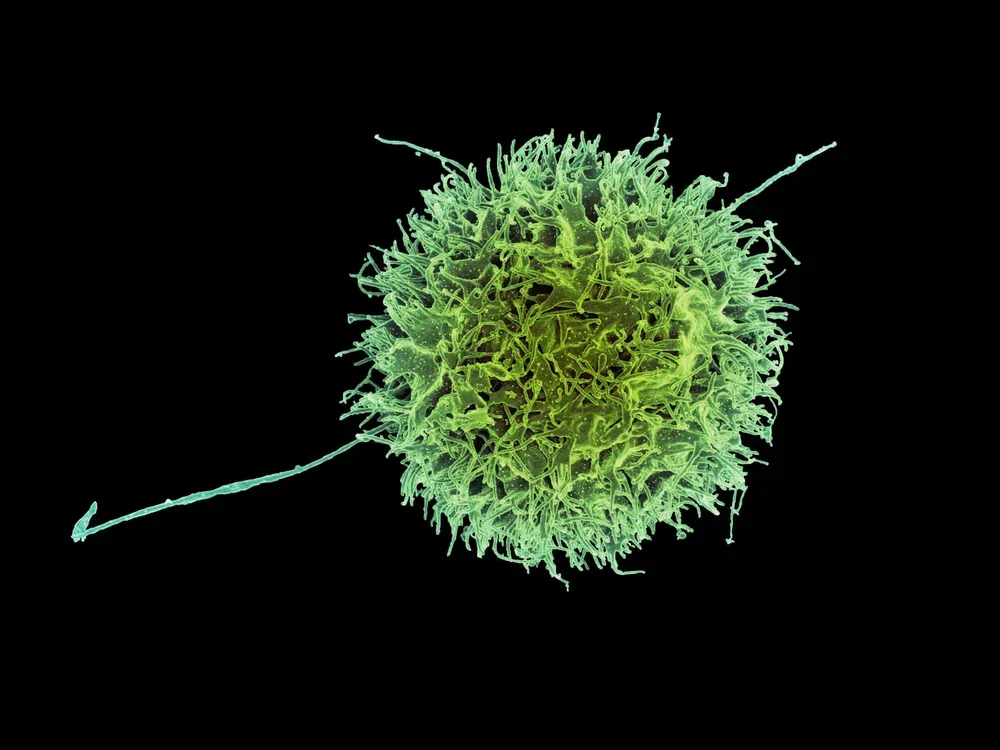
NK cells recognize transformed cells without prior sensitization. They express RANK. Experimental work has shown that platelets in contact with circulating tumor cells can raise RANKL and, by binding RANK on NK cells, blunt their activity. One piece of an immunosuppressive puzzle; dose, timing and weight versus other pathways still need clinical clarity.
What changes in the chair
The RANK/RANKL/OPG system runs remodeling in the jaws. Extraction, alveolar bone, implant, orthodontic movement: all of it passes through here.
The patient on denosumab has blocked osteoclastogenesis and reduced turnover. At oncology doses, medication-related osteonecrosis of the jaw after invasive procedures is a concrete planning problem. At osteoporosis doses the picture is softer.
Mirza and colleagues, a 2025 meta-analysis in Endocrine Practice informing the international osteonecrosis task force, look at implants and antiresorptives in osteoporosis: nine studies (n = 655) on implant failure with relative risk 0.82 (95% CI 0.52–1.28; very low certainty) — a wide interval, no clear signal of higher failure. In an implant-level sensitivity analysis, antiresorptives even associate with fewer failures (RR 0.53), still at very low certainty. The pooled MRONJ rate after implantation among patients on antiresorptives is about 0.5% across 21 cohorts. One risk-adjusted bisphosphonate estimate adds roughly 3 MRONJ cases per 1000 patients. Practical translation: do not refuse implants a priori in the osteoporotic patient on therapy; plan, document, and keep osteonecrosis on the checklist.
La Monaca and colleagues, in Journal of Oral Pathology & Medicine in 2025, review 51 studies (18 in meta-analysis) on peri-implant crevicular fluid biomarkers. Among 96 molecules, RANK, RANKL and OPG return often; the sRANKL/OPG ratio, together with IL-1β, VEGF and cortisol, shows moderate predictive value for peri-implantitis. The RANKL signal is measurable in the sulcus when peri-implant tissues inflame.
In periodontitis, infiltrating T cells produce RANKL and supporting bone is lost. Bacteria matter. So does a dysregulated immune response that keeps RANKL on. That low-grade chronic inflammation does not stay in the mouth alone.
The molecules stay the same. Context decides what they do. Read a patient — gums, radiograph, drug list — with this triad in mind, and surgical and pharmacologic choices get quieter and sharper.
FAQ
What is the RANK/RANKL/OPG system and what does it do in bone and immunity?
How does RANK/RANKL/OPG affect bone in autoimmune disease and cancer?
What role do dendritic cells and T lymphocytes play in immunity and bone remodeling?
Does denosumab raise the risk of jaw osteonecrosis and implant failure?
Why should a dentist know RANKL, RANK and OPG in daily practice?
References
- Yasuda H. Discovery of the RANKL/RANK/OPG system. J Bone Miner Metab. 2021;39(1):2-11. doi:10.1007/s00774-020-01175-1 · PMID: 33389131
- Ono T, Hayashi M, Sasaki F, et al. RANKL biology: bone metabolism, the immune system, and beyond. Inflamm Regen. 2020;40:2. doi:10.1186/s41232-019-0111-3 · PMID: 32047573 · free full text
- Chi G, Qiu L, Ma J, et al. The association of osteoprotegerin and RANKL with osteoporosis: a systematic review with meta-analysis. J Orthop Surg Res. 2023;18(1):839. doi:10.1186/s13018-023-04179-5 · PMID: 37932757 · free full text
- La Monaca G, Pranno N, Patini R, et al. Biomarkers in Peri-Implant Crevicular Fluid of Healthy Implants and Those With Peri-Implant Diseases: A Systematic Review and Meta-Analysis. J Oral Pathol Med. 2025;54(5):267-282. doi:10.1111/jop.13612 · PMID: 40101934 · free full text
- Mirza R, El Rabbany M, Ali DS, et al. Dental Implant Failure and Medication-Related Osteonecrosis of the Jaw Related to Dental Implants in Patients Taking Antiresorptive Therapy for Osteoporosis: A Systematic Review and Meta-Analysis. Endocr Pract. 2025;31(9):1189-1196. doi:10.1016/j.eprac.2025.06.003 · PMID: 40505730
- Tang T, Wan B, Zhang A, et al. Efficacy of denosumab in treatment of osteoporosis in patients with rheumatoid arthritis: a meta-analysis of randomized controlled trial. BMC Musculoskelet Disord. 2025;26(1):450. doi:10.1186/s12891-025-08688-8 · PMID: 40335975 · free full text
- Vethencourt A, Trinidad EM, Dorca E, et al. Denosumab as an immune modulator in HER2-negative early breast cancer: results of the window-of-opportunity D-BIOMARK clinical trial. Breast Cancer Res. 2025;27(1):68. doi:10.1186/s13058-025-01996-w · PMID: 40350430 · free full text
- Chang H, Marquez J, Chen BK, et al. Immune Modulation with RANKL Blockade through Denosumab Treatment in Patients with Cancer. Cancer Immunol Res. 2024;12(4):453-461. doi:10.1158/2326-6066.cir-23-0184 · PMID: 38276989 · free full text
- Mabrut E, Mainbourg S, Peron J, et al. Synergistic effect between denosumab and immune checkpoint inhibitors (ICI)? A retrospective study of 268 patients with ICI and bone metastases. J Bone Oncol. 2024;48:100634. doi:10.1016/j.jbo.2024.100634 · PMID: 39381634 · free full text
- Yasuda H. Discovery of the RANKL/RANK/OPG system. J Bone Miner Metab. 2021;39(1):2-11. doi:10.1007/s00774-020-01175-1 · PMID: 33389131
- La Monaca G, Pranno N, Patini R, et al. Biomarkers in Peri-Implant Crevicular Fluid of Healthy Implants and Those With Peri-Implant Diseases: A Systematic Review and Meta-Analysis. J Oral Pathol Med. 2025;54(5):267-282. doi:10.1111/jop.13612 · PMID: 40101934 · free full text
- Mirza R, El Rabbany M, Ali DS, et al. Dental Implant Failure and Medication-Related Osteonecrosis of the Jaw Related to Dental Implants in Patients Taking Antiresorptive Therapy for Osteoporosis: A Systematic Review and Meta-Analysis. Endocr Pract. 2025;31(9):1189-1196. doi:10.1016/j.eprac.2025.06.003 · PMID: 40505730
- Tang T, Wan B, Zhang A, et al. Efficacy of denosumab in treatment of osteoporosis in patients with rheumatoid arthritis: a meta-analysis of randomized controlled trial. BMC Musculoskelet Disord. 2025;26(1):450. doi:10.1186/s12891-025-08688-8 · PMID: 40335975 · free full text
- Vethencourt A, Trinidad EM, Dorca E, et al. Denosumab as an immune modulator in HER2-negative early breast cancer: results of the window-of-opportunity D-BIOMARK clinical trial. Breast Cancer Res. 2025;27(1):68. doi:10.1186/s13058-025-01996-w · PMID: 40350430 · free full text
Cite this article
Ready for theses, slides and papers. If you cite it on a web page, make the URL a link so readers can reach the source.
Bruschi E. Bone Metabolism Mediators: Molecules with 1000 Functions [Internet]. Frosinone (Italy): Bonebenders; 2026 [updated 2026 Sep 14; cited 2026 Oct 25]. Available from: https://bonebenders.com/en/blog/bone-metabolism-mediators-molecules-with-1000-functions/ Bruschi, E. (2026, January 19). Bone Metabolism Mediators: Molecules with 1000 Functions. Bonebenders. https://bonebenders.com/en/blog/bone-metabolism-mediators-molecules-with-1000-functions/
@misc{bruschi2026bone,
  author       = {Bruschi, Ernesto},
  title        = {Bone Metabolism Mediators: Molecules with 1000 Functions},
  year         = {2026},
  month        = jan,
  howpublished = {Bonebenders},
  url          = {https://bonebenders.com/en/blog/bone-metabolism-mediators-molecules-with-1000-functions/},
  note         = {Accessed 2026-10-25}
} Go deeper
Espansione crestale (split crest) →Allargare la cresta senza trapianto — tecnica ERE e bonebending
Need a professional opinion?
Book an appointment at Dr. Bruschi's practice in Frosinone. First visit includes full diagnosis and personalised treatment plan.
Stai valutando un impianto dentale?
Ti hanno detto che non hai abbastanza osso, o ti hanno proposto un’arcata fissa? Ho scritto una guida di dieci pagine: le strade possibili, gli esami che servono e le dieci domande da fare prima di firmare.
Ricevi la guidaStay Updated
New articles on periodontology, implantology and oral surgery — delivered to your inbox.
Comments
Loading comments...
Leave a comment