When chromosomes grow tired: centromeres, cellular aging, and cancer risk
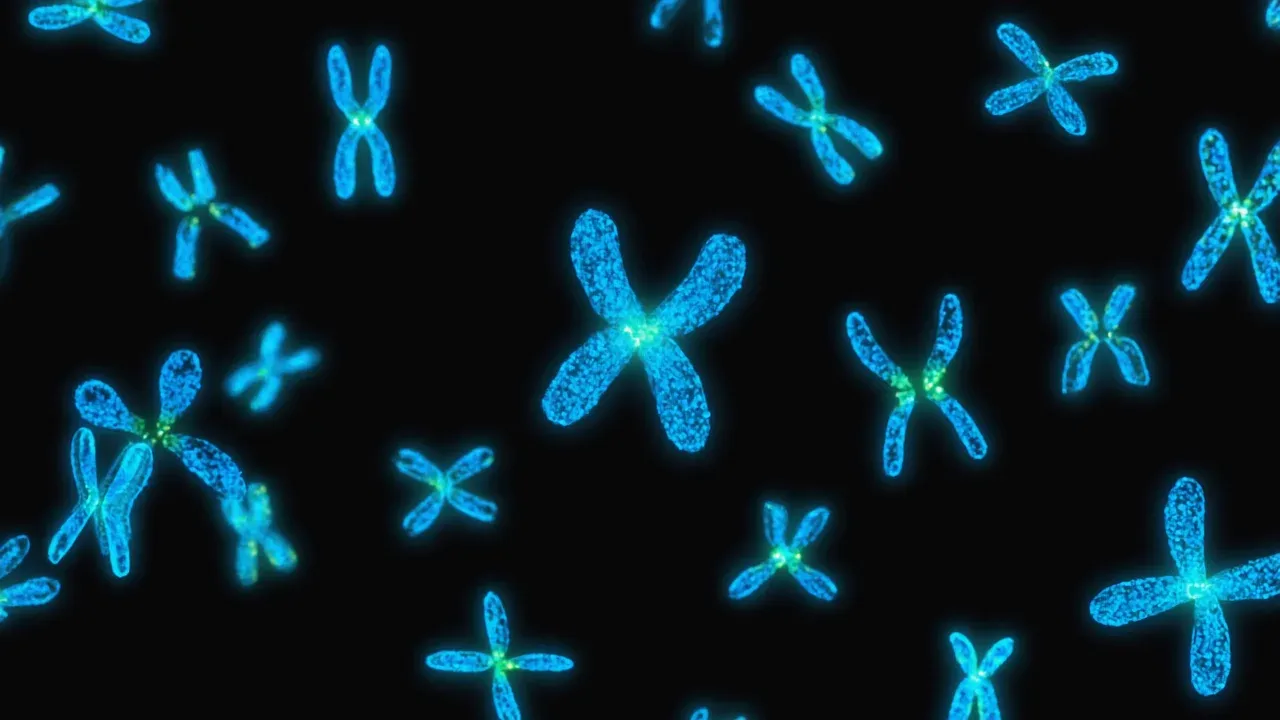
In brief — Human centromeres lose the key protein CENP-A as early as middle age, causing disorganized chromosomes and higher cancer risk. NIH researchers showed this process can be reversed in lab cells by dual inhibition of p53 and LSD1 — opening a new window in aging biology.
Your 65-year-old patient heals more slowly. You’ve noticed it. Gingival tissue responds with less vigor, osseointegration takes longer, keratinized tissue barely thickens. The standard explanation covers immunosenescence, reduced vascularity, systemic medications. All valid.
But something more fundamental is happening inside the nucleus of every cell that tries to divide.
While everyone watched the telomeres, the chromosome’s center concealed an important mechanism
Centromeres are the chromosomal anchor points for the mitotic spindle — protein fibers that physically pull the two copies of each chromosome toward opposite poles of the dividing cell. The mechanism ensures that every daughter cell receives exactly the right chromosomal set. An error here isn’t minor: a daughter cell with extra or missing chromosomes is, by definition, aneuploid. Aneuploidy is one of the most consistently documented molecular precursors to carcinogenesis.
For decades, it was assumed centromeres functioned the same way regardless of the patient’s age.
They don’t.
The discovery: CENP-A declines with age, and chromosomes lose their footing
In January 2025, Sweta Sikder and Yamini Dalal of NIH’s Center for Cancer Research published a systematic study in Molecular Cell on human skin fibroblasts from three age groups: young (20–39), middle-aged (40–59), and older adults (60–79).
The protein under examination was CENP-A — a centromere-specific histone H3 variant, essential for building the structure that attaches to the mitotic spindle. Without functional CENP-A, chromosomes aren’t separated correctly. Sikder’s data show that CENP-A levels start declining in the 40–59 age group. The same applies to CENP-C, a partner protein that maintains centromere integrity together with CENP-A. Similar CENP-A losses were documented in kidney and lung fibroblasts, with slightly different timing across tissue types.
Under the microscope, chromosomes in aged cells look blurred and disorganized. Sikder’s description: “completely disorganized and fuzzy looking.” Fewer cells complete healthy division cycles, and those that do often show abnormal chromatin structures.
The mechanism: p53 and LSD1, an axis that shuts down centromeres
Why does CENP-A decline? Not randomly. There’s a precise molecular axis.
Aging cells show elevated p53 — the “guardian of the genome,” the protein that normally activates DNA repair or triggers apoptosis in damaged cells, preventing the transmission of genomic errors. A tumor suppressor of fundamental importance.
With aging, though, p53 appears to activate a second, previously unappreciated effect. It promotes recruitment of LSD1 (also known as KDM1A), a histone demethylase, to centromeres. LSD1 at centromeres suppresses the noncoding transcription that is normally required to load new CENP-A molecules. Without that transcription, CENP-A turnover stops. Centromeres progressively inactivate.
It’s an epigenetic short circuit: the anti-cancer defense system (p53) activates, as a side effect, a mechanism that undermines the fidelity of cell division — and paradoxically increases long-term cancer risk.
The reversal: dual inhibition, rejuvenated mitosis
The most striking finding of the study is that this process is, at least partially, reversible.
By simultaneously inhibiting p53 and LSD1 in aged fibroblasts, Sikder and colleagues restored CENP-A levels and reactivated centromeric transcription. Under the microscope, treated cells looked and behaved like younger cells. The authors describe this as “mitotic rejuvenation.”
This is cell culture work. No patients, no drugs. But the door is open.
What this means for the mouth
Skin fibroblasts and periodontal ligament fibroblasts are biologically similar cells — both produce collagen, maintain connective tissue integrity, and participate in wound healing. If centromere dysfunction from CENP-A loss manifests in skin fibroblasts already in the 40–59 age group, the same dynamic is plausibly active in the gingival fibroblasts of your patients.
This has direct clinical implications on two levels.
Level 1 — Impaired healing. The reduced periodontal response in elderly patients isn’t only about immunosenescence or vascularity. There’s a defect in cell division itself: cells that should reconstitute tissue do so less accurately. The stem cells in the periosteum that, after implant placement, must replicate precisely to repair surrounding tissue depend on functional centromeres. So does the osteocyte network coordinating bone’s mechanical response.
Level 2 — Oral cancer risk. Oral squamous cell carcinoma peaks between ages 55 and 75. It is characterized by chromosomal instability — aneuploidies, deletions, amplifications. Progressive centromere inactivation through CENP-A loss is precisely the type of upstream mechanism that takes a normal cell toward altered genomic architecture. The timing is not coincidental: the age groups most affected by oral cancer are the same groups where this study documents the most severe CENP-A loss.
There is also the shared biology between systemic disease and periodontal aging. Bone remodeling, osteoblast differentiation, and the precision of skeletal cell division are all affected by the same aging mechanisms documented in this study.
LSD1 and bone biology: a double thread
A detail worth noting: LSD1/KDM1A doesn’t act only on centromeres. It’s a modulator of osteoblast differentiation. Prior studies indicate that LSD1 inhibition in osteoblast precursors promotes mineralization and matrix deposition. This creates a complex overlap: the same molecule involved in centromere inactivation during aging also regulates bone formation.
Any therapeutic strategy targeting LSD1 will need to account for skeletal effects — which becomes clinically relevant the moment you’re dealing with a patient who has limited residual bone, active periodontal disease, or implants in function.
Required caveats
This is a study on skin fibroblasts in culture and in post-mortem tissue. No animal model, no patients, no in vivo drug administration. Inhibiting p53 — a foundational tumor suppressor — raises legitimate concern: sustained inhibition could open an oncological vulnerability that the body was trying to close. The authors are explicit: this describes a biology, opens a window, points to a direction. Nothing more.
But the direction is clear.
Reference
Sikder S, Baek S, McNeil T, Dalal Y. Centromere inactivation during aging can be rescued in human cells. Mol Cell. 2025 Feb 20;85(4):692-707.e7. doi:10.1016/j.molcel.2024.12.018. Epub 2025 Jan 13. PMID: 39809271.
FAQ
What are centromeres and why do they matter?
Does CENP-A loss directly cause cancer?
Why do older patients heal more slowly after implant placement?
Are there existing drugs that target LSD1?
Is it safe to inhibit p53 to slow aging?
References
- Sikder S, Baek S, McNeil T, et al. Centromere inactivation during aging can be rescued in human cells. Mol Cell. 2025;85(4):692-707.e7. doi:10.1016/j.molcel.2024.12.018 · PMID: 39809271
- Sikder S, Baek S, McNeil T, et al. Centromere inactivation during aging can be rescued in human cells. Mol Cell. 2025;85(4):692-707.e7. doi:10.1016/j.molcel.2024.12.018 · PMID: 39809271
Cite this article
Ready for theses, slides and papers. If you cite it on a web page, make the URL a link so readers can reach the source.
Bruschi E. When chromosomes grow tired: centromeres, cellular aging, and cancer risk [Internet]. Frosinone (Italy): Bonebenders; 2026 [updated 2026 Jun 23; cited 2026 Sep 27]. Available from: https://bonebenders.com/en/blog/cenp-a-centromere-aging-cancer-risk/ Bruschi, E. (2026, June 23). When chromosomes grow tired: centromeres, cellular aging, and cancer risk. Bonebenders. https://bonebenders.com/en/blog/cenp-a-centromere-aging-cancer-risk/
@misc{bruschi2026cenp,
  author       = {Bruschi, Ernesto},
  title        = {When chromosomes grow tired: centromeres, cellular aging, and cancer risk},
  year         = {2026},
  month        = jun,
  howpublished = {Bonebenders},
  url          = {https://bonebenders.com/en/blog/cenp-a-centromere-aging-cancer-risk/},
  note         = {Accessed 2026-09-27}
} Go deeper
Espansione crestale (split crest) →Allargare la cresta senza trapianto — tecnica ERE e bonebending
Need a professional opinion?
Book an appointment at Dr. Bruschi's practice in Frosinone. First visit includes full diagnosis and personalised treatment plan.
Stay Updated
New articles on periodontology, implantology and oral surgery — delivered to your inbox.
Comments
Loading comments...
Leave a comment